THE RATTLESNAKE TOKEN!
Collecting Civil War tokens is an interesting pursuit just loaded with history of the Great War between the States. Regular issues of US coinage was hoarded during the Civil War and this dramatically restricted merchants ability to make small change. In response to this situation, many of the merchants had tokens made to give out as change in their stores. If you ordered the least expensive tokens you would receive a combination of two existing dies, usually of a Patriotic nature or similar to a US cent. We refer to these tokens as Patriotic Civil War Tokens.
If on the other hand you had more to spend for tokens you could have custom dies prepared with specific information relating to your business (i.e. location, occupation, specialties, etc.) these are referred to as Civil War Store Cards. These tokens are often refered to as Tradesmen Tokens.
Given the above information, it is not surprising that collectors in general classify Civil War tokens as either Patriotic or Store Cards (there are others we will cover later). Now get ready; there were some 50,000,000 or more of these tokens issued! Approximately 10,000 different varieties have been recorded! This area of numismatics represents an abundance of affordable small pieces of copper that represent a very important part of the fabric that makes this country what it is today. There are almost endless ways of assembling Civil War Tokens (CWT) by variety or topic for the collector. Want a history lesson of the early 1860’s…..this is a wonderful place to begin.
Patriotic tokens are anonymous, as mentioned above, struck from stock dies for general circulation. These tokens have patriotic themes – ARMY & NAVY, THE FLAG OF OUR UNION, LIBERTY AND NO SLAVERY, etc. – but some “Copperhead” tokens were issued with designs critical of the war, such as MILLIONS FOR CONTRACTORS/NOT ONE CENT FOR THE WIDOWS.
Store cards were made with their issuers and generally carry an advertisement for the issuers business. One of my favors are the tokens bearing a mortar and pestle, relating to medicinal agents of the time. However, other items like trunks, stoves, a stein of beer, animals and many more were used. On the other hand, many show simply a stock die such as an Indian head, eagle, or patriotic theme.
In reality, cent-size copper tokens were first issued before the Civil War. There are examples of issues as early as 1858 and 1861, These pre-Civil War tokens are usually collected together with the genuine article due to the difficulty of confidently separating them and the long exiting collecting tradition. Some of the more recent catalogues do identify many of them as “non- contemporary” issues.
.
Now with that background for those not familiar Civil War Token collecting, lets get on to the main subject of this article, the “Rattlesnake Token”. This token is appealing for several reasons but formost is its symbolism as far back as colonial times in this country( i.e. at least 1750 or so). The rattlesnake was the favorite animal emblem of the Americans even before the Revolution. Moreover, no one can misinterpret either the partial or full phrase, “LIBERTY OR DEATH: DONT TRED ON ME”, found of the flags of 1775 along with either coiled, or full length rattlers decorating the sacred hand woven material this all resided on.

On the Obverse: The Union Must and Shall Be Preserved.
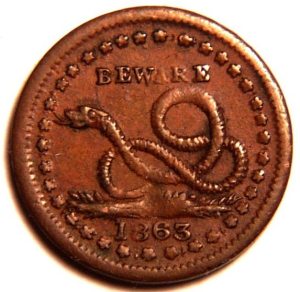
On the Reverse: “Beware”, shown above the snake with the date 1863 beneath.
This die marriage is 136/397.
The rattlesnake has been a favorite symbol of independence throughout America’s history. It was first adopted as a uniquely American ICON by early patriots such as Benjamin Franklin. The rattlesnake represented American unity. For example, individually, its rattles have no sound, but united, they can be heard by all. Moreover, while it does not strike unless threatened, once provoked, the deadly rattlesnake will never surrenders.
Opponents of the Civil War were also known as “Copperheads”) and criticized Lincoln for refusing to compromise on the slavery issue.
The Civil War Token we are interested in falls into “Patriotic” series. The firebrand design of the Gadsden Flag serves as a reminder of the birth of our nation and the spirit that carried it to freedom. The bright yellow banner bears an ominous coiled rattlesnake with the warning “Don’t Tread on Me.”
Confederate iron rattlesnake waist belt buckle very similar to the one in Mullinax’s Confederate Belt Buckles & Plates book, expanded edition, page 114, plate 201.
UPDATES TO FOLLOW.
Read Full Post »


 Gammill Coin Gazette
You must be logged in to post a comment.