Feeds:
Posts
Comments

1794 Large Cent

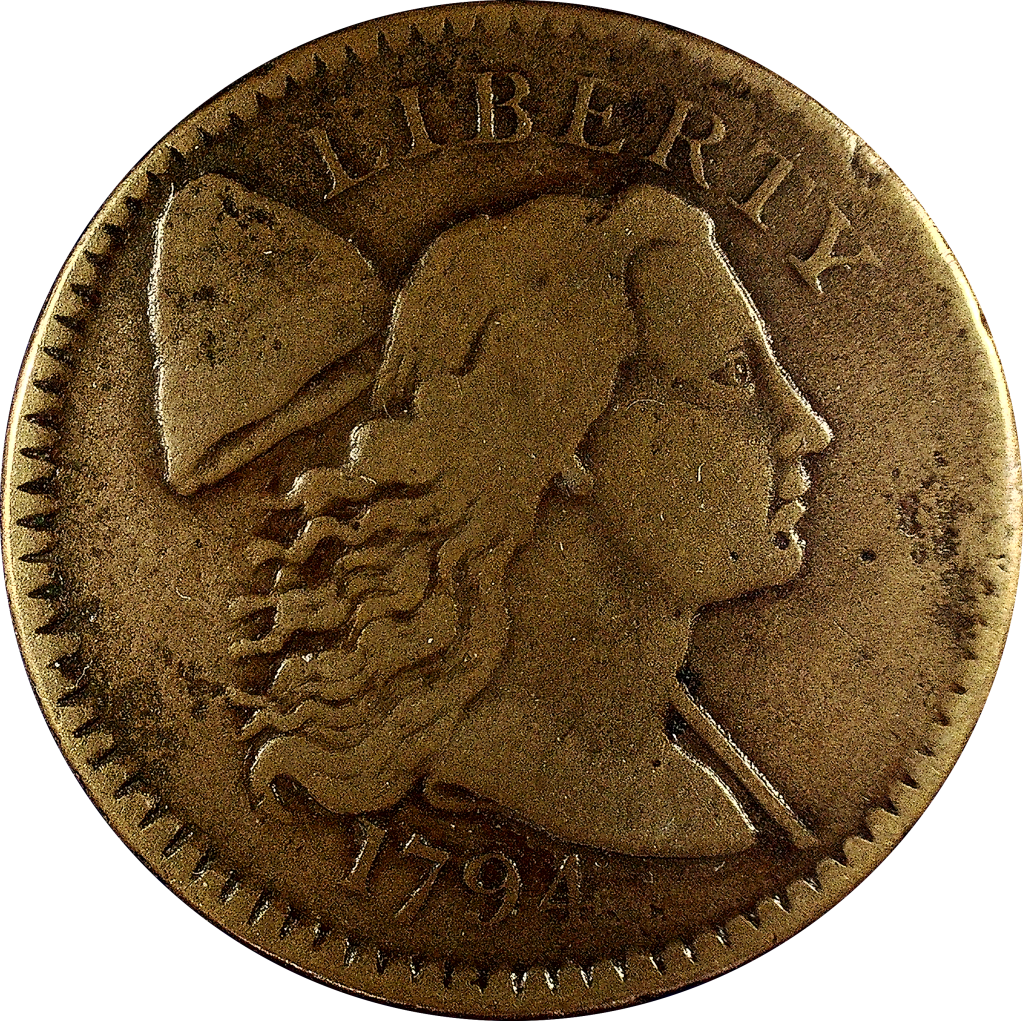
A very nice example of the S-64 from the Dr. Ronald B. Gammill Collection of US Large Cents. The S-64 is an R-5 variety and this specimens exhibits sharp detail and pleasing eye appeal given its exceptional state of preservation. This coin was purchased from Tom Deck. Its provenance is: CVM, 10/2011; Shawn Yancy; Jack D. Young, 4/2011; Shawn Yancey, 11/2012; Roger Mills, 12/2012 and finally Dr. Gammill, 2016. The border milling on the left side of the coin is always deep and heavy and protects and strengthens the hair detail as well as the entire left side of the coin. This is true for both obverse and reverse for the S-64 variety. Liberty is well spaced and closer to the hair than the border. The sharpness of the eye captures your attention immediately upon viewing this specimens.

Graded F-12, the obverse and reverse of this S-64 has a pleasing chocolate color with smooth hard surfaces and only minor pitting in front of Liberty’s face and behind the lower curls. Liberty, cap, pole and date are all defined and evenly struck. Except for their absence between 1 – 3 o’clock, the dentils are well defined and the saw tooth features are particularly strong between 7 – 10 o’clock.
The reverse clearly defines a Late Die State (Breen V) with the strong radial die crack through the ‘D’ in UNITED, the swelling inside the wreath and the missing Fraction Bar. The dentils are well defined and overall eye appeal is strong.

1948 Mint State Lincoln Cent (Bull’s-Eye Toning)

Some twenty years ago, Martha and I were attending the Michigan State Numismatic Show in Dearborn, MI.  An elderly gentlemen came up to our table, and said several dealers told him that we liked copper.  True.  He then proceeded to tell us that he had a small coin collection that he had amassed over the years, wondered if we were interested in taking a look at it and, if interested, purchase it.  I asked him if had brought anything to show us, and he replied, I have a few Indian Head Cents and some tokens for you.   His coins were all nice and original (original skin, if you will) and many were attractive AU’s and Mint State examples.  None of these coins were toned to any noticable extent.  We talked for some time.  He had been collecting US Coins and Token since the end of World War II, and explained that he had come to the point that it was time to sell his collection.  It was interesting to me that it appeared the coins he presented at the show had been stored away for some time.  Many were wrapped in old tissue paper or in old 2X2 paper envelopes.  However, he was quick to point out that  most of his really nice coins were in old coin albums.  I asked National Albums?  He replied, yeah, I’ve got some of those I believe.  My interest then peaked!  We offered him a price for the coins he had with him, and then told him to shop his coins around the bourse floor, and, if our offer was competitive, come back to see us, and we would make an appointment to view the rest of his collection.  His wife was with him and really didn’t seem very interested in the coins, but was enjoying looking at some of the jewelry on display at several of the tables at the show.

A couple hours passed and the couple came back to our table.  They said they were interested in our offer, but really wanted to sell the entire collection, and encouraged us to visit them at their home in Battle Creek, MI, to view the entire collection.

So, the rest of the story:   After returning from the MSNS show, we arranged a visit with the couple at their home in the Battle Creek countryside .  Now I am speculating, but my best guess was these folks were in their late 70’s at the time of our visit.  They had a very nice comfortable home and were very gracious hosts during our visit.  We learned that the gentlemen had been a life-long farmer in the Battle Creek area, and his wife had been a homemaker.  They had children, but none of the kids were interested in their collection, and it was just time to sell.

They walked us down a hallway to a large bedroom in which an old wooden chest was at the foot of the iron-post bed.  Everything in that room, and their house for that matter, reminded me of my grandparent’s home!  Now the old fellow opened the wooden chest, and it was full of coin albums, boxes of coins carefully labeled and stored in envelopes, sometimes wrapped in old tissue paper as well as related Numismatic Memorabilia (early Max Mehl catalogues, for example).

1946 Mint State Lincoln Cent (Bull’s-Eye Toning).

Of all the coins we saw that afternoon, and eventually purchased, the Lincoln Cents, Proof and Mint Sets, were covered in absolutely spectacular toning.  Both Martha and I had attended Bob Campbell’s course in Colorado Springs at the ANA Summer Seminar Series which was on the characteristics of natural and artificial toning, and we were immediately confident that what we were viewing, was in fact, beautifully undisturbed and original examples of natural toning on copper.

Toning is all about storage techniques, and is the result of a long and slow oxidative process in which chemicals in the environment interact with the surface of the coin.  The Lincoln Cents, Proof and Mint Sets had been stored in that trunk, undisturbed to varying degrees since the late 1940’s and 1950’s.  The old fellow told us that the trunk was what his belongings were shipped home in at the end of his service in WW II.  I wish I could tell you the type of wood that old trunk was made of, but that detail is missing.  The albums ranged from the old National Albums, Library of Coins Albums and various Whitman Albums.  The Lincoln Cents were housed in a “Library of Coins” album.  For the most part they appeared to have been carefully chosen Mint State or near Mint State examples, certainly quality-wise much better than the Indian Head Cents in his collection.  I asked him about the source of his collection over the years.  His reply, as I recall, was that he had gotten them from local banks, friends and occasionally local dealers and coin shows.  I asked him if he had ever sold any of his coins before now.  He said no, never sold a thing.  I’m guessing from our visit that many in the area knew of his collecting interest and frequently offered him small family accumulations.   Sometimes, when dealing with collectors, buying or selling, you learn a lot about their personality.  In this case, we were dealing with very knowledgable and meticulous folks.  Details and organization were a top priorities in every aspect of their life( at least as viewed by us).  They resided in a very comfortable farm home with every thing in its place!  They appeared to be happy and very content in their community, and were enjoying their senior years with great clarity and confidence.   These were people you like to know and call friends.

1959 D Mint State Lincoln Cent (Iridescent Green Toning)

Many of the Lincolns in his collection had not only spectacular ‘Bull’s-Eye’ toning but also beautiful deep intense iridescent green toning, which was incredibly thick, almost to the point of obscuring the underlying mint luster.  However, under direct light the original mint luster was in full beauty.  I am sure a professional photographer could make these coins truly remarkable examples of  natural toning on copper.

1946 D Mint State Lincoln Cent (Iridescent Green & Rose Toning)

How do we grade these raw uncirculated examples?   Well, we just call them Mint State Beauties, free from plastic encapsulation, for the time being.   The coins pictured in this article represent about 10% of the toned wheat cents (30’s,40’s & 50’s) in our Battle Creek Toned Lincoln Collection.  If you think grading is a subjective exercise in establishing value…grading toned mint state examples is really subjective.  Some folks believe toning is surface damage and stay away from buying them.  Others view toning as beauty, adding great value to the coin.  In our present numismatic market, almost all markable and beautifully toned coins are going to be encapsulated by either PCGS or NGC.  Encapsulated/Certified coins are the market makers and are guiding grade and value in almost every aspect of collecting.   We certainly buy and sell in the certified market, but in some cases, as in this example, we prefer to view the originality, free from plastic, at least for the time being!

We purchased this collection raw, not a certified coin in it.  Were we fair?  Did we pay this couple a premium for what was clearly a collection with some unique examples?  You bet we did, and here’s why:  First, it was, and is, the correct thing to do.  Your reputation of fairness in dealing with collectibles of any kind is your bond.  In this case, the toning was unique enough to us that we estimated the value of these coins would certainly increase; and demand would be high going forward.  So yes, we paid a premium that yielded an outcome that both buyer and seller could agree upon and be happy with.

Oh, you want to know how much of a premium?  Don’t be like a long-time customer of ours.  Every time we sold him a coin he insisted on driving us crazy by wanting to know what we had paid for the coin.  He wanted to know, and apparently approve, our profit margin…really not his business!  We sold him coins for 15 years, never divulged that information, and apparently he learned to live without knowing every little detail of our business.  He was a great customer but we always knew that question was coming…how much did you pay for this coin?  He became a very dear friend…but we never divulged our cost.

1947 D Mint State Lincoln Cent (Light Iridescent Green with Soft Rainbow Toning)

One Final Note:  How do we store these toned Lincoln Cents?  Well, we place them in a nice cotton pouch, and then that pouch goes into a 2 X 2 paper coin envelope.  Ideally envelopes of low sulfur content (archival quality, if possible).  The coins are then stored in a low humidity environment with air temperature @70 degrees year round.

Continue Reading »
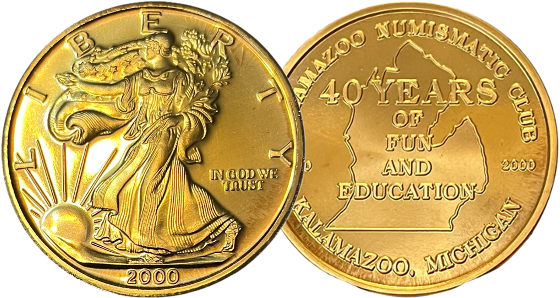
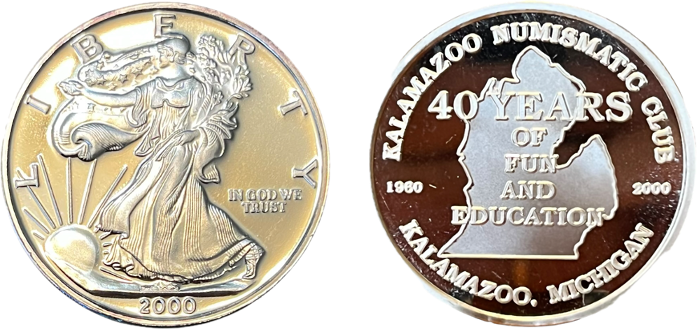
The Kalamazoo Numismatic Club’s 40th Year Anniversary Medals will be available at our Club’s next Auction!1

Gammill Coin Gazette

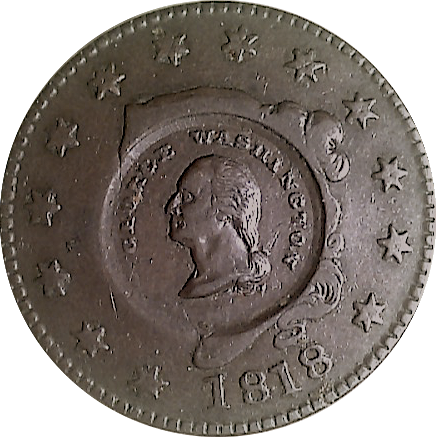
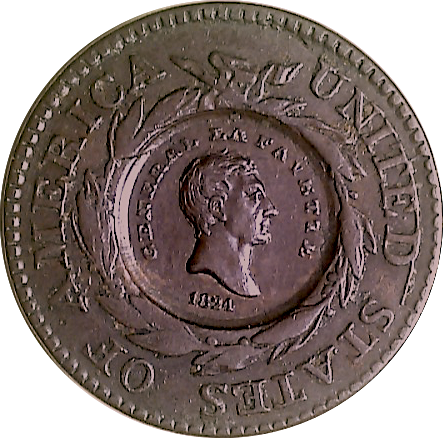
1818 (Newcomb-2) Washington-Lafayette Counter Stamp

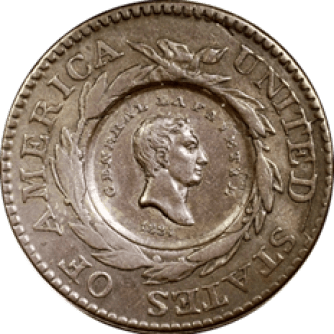
The Washington-Lafayette Counter Stamp is one of the most famous and desirable counter stamps in American history. Rarely are these historically rich pieces seen for sale. For most Early American Copper connoisseurs, these rare pieces represent a culmination of rarity, history, beauty and always, always provide depth to a numismatic collection. Duffield reported that he was aware of the Washington-Lafayette counter stamp on 1817, 1818, 1822 & 1823 large cents. We are also aware of an 1807 half cent with this counter stamp. Current estimation is that the existing known population of these large cents is in the neighborhood of 12.

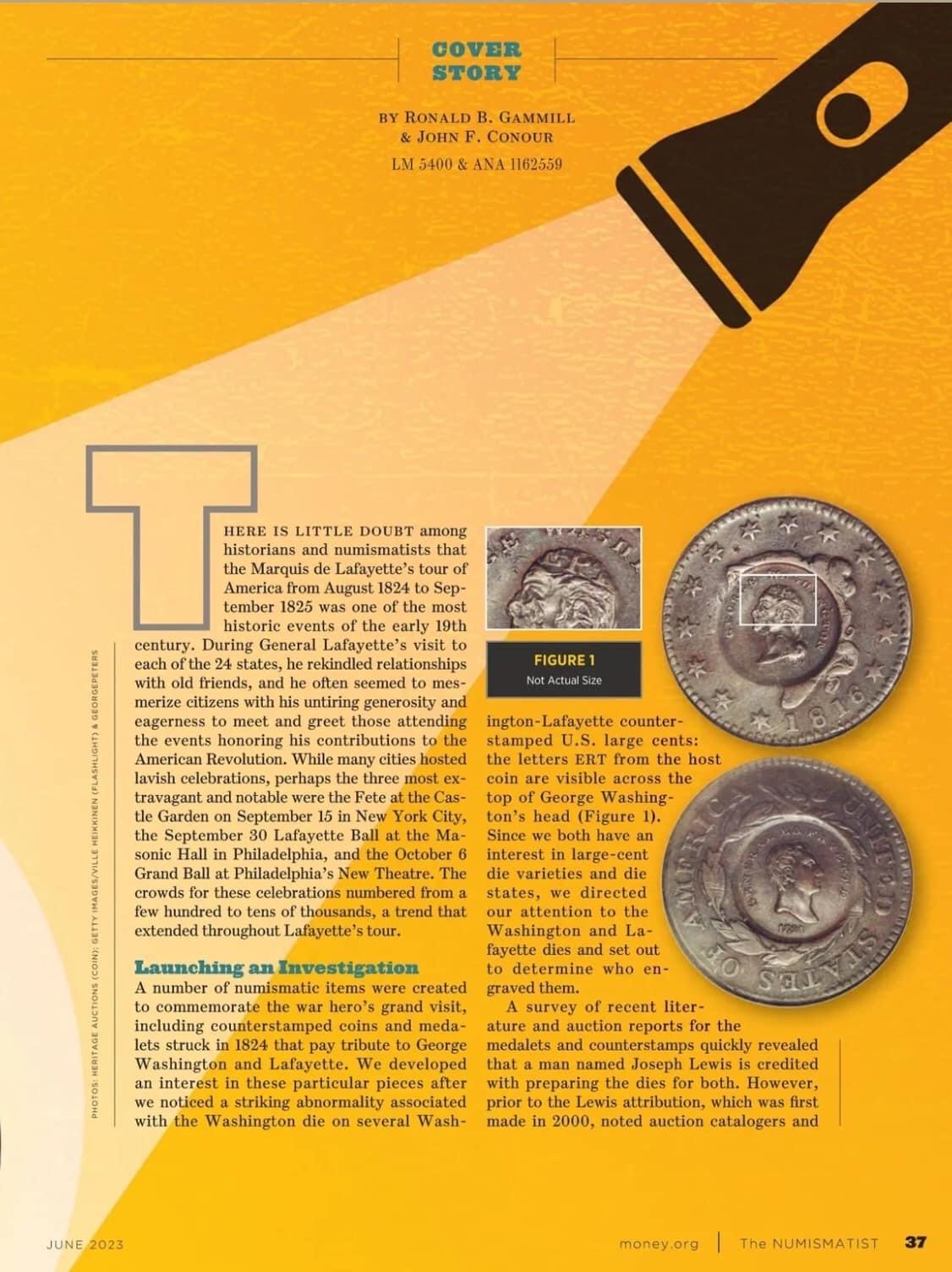
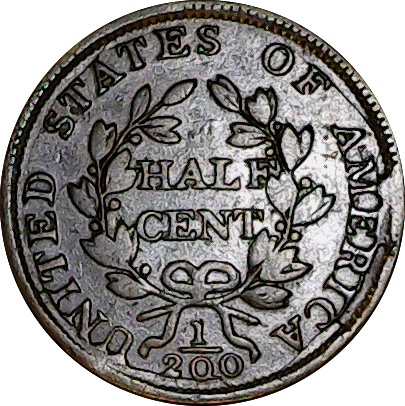
The dies were made by Joseph Lewis for his Washington – Lafayette Medalets. It is these dies that are neatly impressed into the above 1818 (Newcomb-2) large cent. This is an especially intriguing example since to my knowledge, it is only the second known example on the 1818 large cent issue and in this particular case, the host coin is a Newcomb-2 variety, which according to Robinson in ‘Copper Quotes’ (edition 2011), is an R-4. The close date (particularly the center ’81’), the away stars, and stars 3 and 6 pointing in between dentils making the obverse readily identifiable as Obverse 1. Reverse B is likewise readily identified by the heavy die crack above UNITED. Leaf positions (PC+, PR, SPC, & C-) which are totally consist with Reverse B, thus resulting in the Newcomb-2 assignment.

To our knowledge, the only other known example of an 1818 large cent with a Washington-Lafayette counter stamped has a very interesting pedigree and is housed (or captured as some EAC’ers might say) in a PCGS VF-20 holder. This specimen is a Newcomb-3 which is an R-3. The dies used to strike these two coins are somewhat similar. The obverse die for the N-3 (Obverse 2) has *6 pointing to left of the coronet tip and *10 star pointing up to the upper lobe of the hairbun. However, the most discernible difference in differentiating between N-2 and N-3 is the location of *1 and *13 with respect to the date (for an excellent discussion see, Wright, John D. 1992. The Cent Book. Litho Technical Services, Bloomington, MN 55431, pages 36 & 37).

This Washington-Lafayette counterstamps were made in honor of Lafayette’s 1824 to 1825 tour of America in which he visited all 24 states in the Union at that time. Interestingly, at the time of his visit, Lafayette was the last surviving Revolutionary War commander.

The dies used to produce this counterstamp were originally cut to strike tiny 14.5 mm medalets that were worn or suspended from a length of ribbon, or mounted on ornate pendants. All of these pieces are scarce to rare according to many. At some point these medal dies were used to produce counterstamps on various coins dated from 1807 to 1824. These counter stamped coins are of even greater rarity than the medals. The earliest coin used for the host that I am aware of is an 1807 half cent. The host half cent is in poor condition but the date is visible. Large cent examples are found on 1816, 1817, 1818, 1820, 1822, 1823 and 1824 issues. The counter stamp is also found on dimes of 1820, 1821, and 1822; half dollars of 1824; and a Spanish silver one and two real.

Counterstamped coins, such as the 1818 N-2, were made by noted medalist Richard Trested and his apprentice James Bale. The story most generally told is that while Lafayette was being entertained at the Mint during his visit to the United States about 1824, in compliment to Lafayette, each of which party was privileged to offer a coin on which the stamp was made from punches that had been prepared especially for the purpose. Another story is to the effect that during a procession in honor of Lafayette, coins bearing the counterstamps were thrown from one of the carriages to the crowds lining the streets to which the procession passed. There is no evidence that Lafayette visited the US Mint and distribution at a parade seems interesting but unlikely in our opinion.

The finest known example of this rarity on a large cent appears to be an 1820 issue that NGC has graded AU-58. This specific example is far better than the two examples in the May, 2004 Ford sale (lots 194 and 195). This clearly is the finest known example of this scarce and desirable counterstamp.

asdf

asdf

Tokens of all kinds have long been a favorite of ours. As we were recently reviewing a few tokens for an upcoming presentation we decided to put a few up in the “Gammill Coin Gazette” for your review and enjoyment!

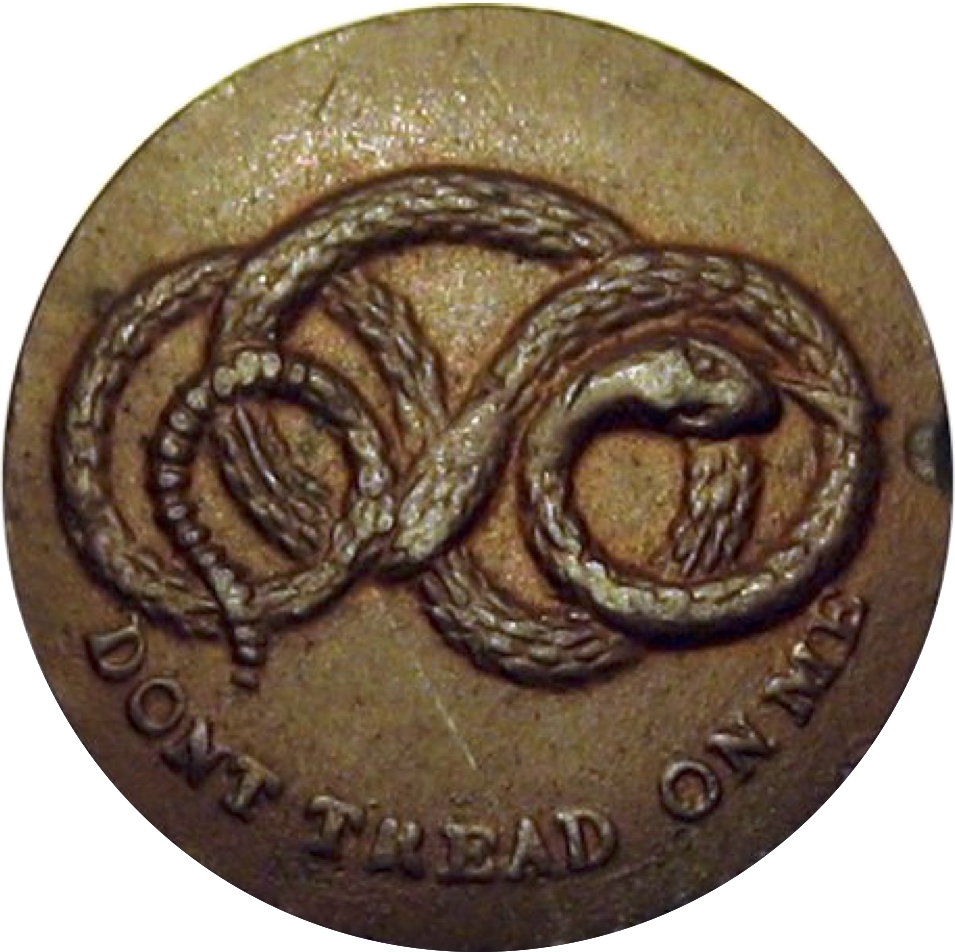
41 - 115A:530
c51d6501-737f-4a4d-b35e-56bcff2eca52_fullsize

41 – 115A/530: Unlisted Raw AU+ Details With nearly full Copper plating with a few light and one more severe rim nicks. Martha Washington Dont Tread On Me with a pretzel shaped snake. This piece has been delisted in the newest Patriotic book because it occurs as an electrotype only. We don’t agree with this decision and feel this is the most legitimate use of die 115A. Most 115A and 115 for that matter were likely made to sell to collectors and were never intended to circulate. This example and 115/530, likely made by a different die sinker using the Lovett obverse as a pattern, did circulate and both come heavily worn and were represented in the “Found In Wall” contemporary hoard of Civil War tokens. From the Steve Tanenbaum collection. (500-750)

47e17a1a-1e70-4c92-85f6-81be1e90c508_fullsize
fb7fe51c-51b0-4ae4-a8c1-4723fc50fe7a_fullsize

568 – MILLER NY 969: MS64 60% Red nearly Proof Like reverse. Woodgate & Co. Wines, New York 1860 Represtd By J. N. T. Levick struck in Copper with a reeded edge. A MS64 Semi Proof Like brought $220 in our September 2010 sale. From the Jon Harris collection earlier from Max Schwartz May 1972.

544 – MILLER NY 815 Raw MS62 10% Bright with 40% of original silvering remaining more so on the reverse. Jas. S. Smith & Co. Military Goods, New York with a military hat struck in Silvered Brass with Plain edge. Only listed in Silvered Copper but all we have seen appear to be Brass. From the John Ford and F. C. C. Boyd collections in March 1958. (50-75)

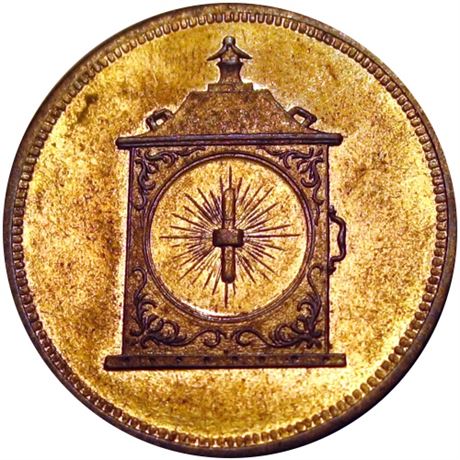
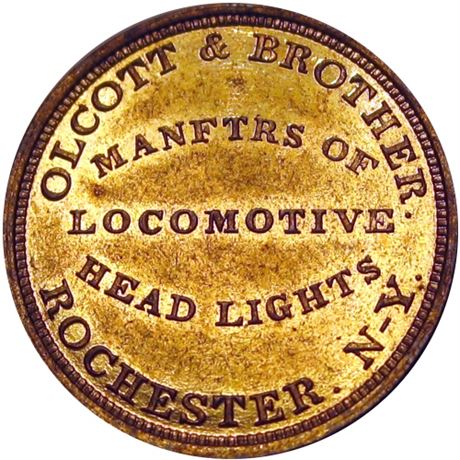
557 – MILLER NY 1019 Raw MS62 30% Bright. Olcott & Brother Locomotive Head Lights, Rochester New York struck in Brass with Reeded edge and railroad headlamp pictured. From the Jon Harris collection. (75-100)

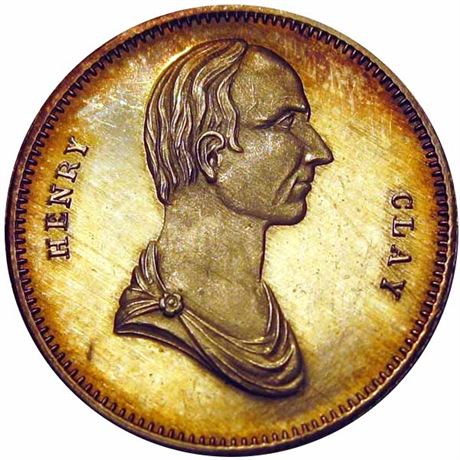
703 – HC-A MS61 Nearly Proof Like with some light hairlines and nice toning. Henry Clay (around draped bust right) // The Union And The Constitution The Eloquent Advocate Of Protection To Home Industry. Silver 28mm. Struck around 1860 by Robert Lovett Jr. One of just ten struck in this composition. ($220)

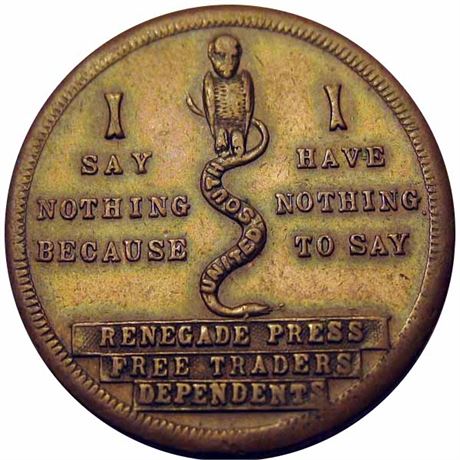
696 – GC 1884-11 EF+ With a couple of light rim bumps. Beef Takes The Presidential Chair March 4 1885 R.R.R. Did It (below buffalo) // I Say Nothing Because I Have Nothing To Say Renegade Press Free Traders Dependents (with head of man on bird sitting on snake labeled United South). An interesting satirical piece with much symbolism said to be struck by J. N. T. Levick. Copper 28mm. An MS63 brought $250 in our June 2013 sale. From the Henry South collection. ($157)

650 – MILLER PA 505C UNC Details Nicely toned but the Taylor side is retoned from an old cleaning with some very light hairlines. A. B. Taylor 1860 Walnut & Ninth Sts., Philadelphia Pennsylvania with Always On Hand reverse struck in Copper with Plain edge. Unlisted in Adams, Miller and Rulau, though we do know of one other. From the Louis Kaufman collection. ($100)

640 – MILLER PA 418 MS63 20% Bright. W. H. Richardson, No. 5 South 4th St. Philadelphia with Umbrellas and Parasols pictured on reverse struck in Brass with Plain edge on a somewhat thinner than normal planchet. From the Richard Crosby collection. ($65)

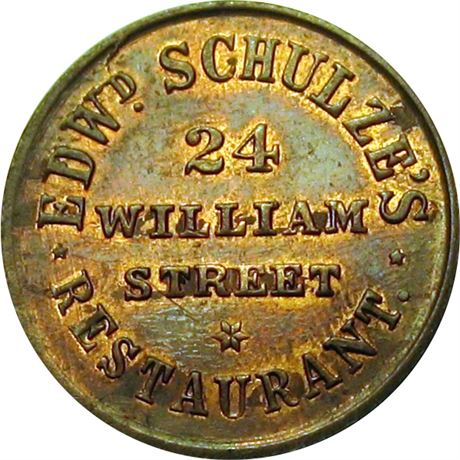
209 – NY630BO-2a R1 MS62 20% Red. Edward Schulze’s featuring deer with antlers. From the Virg Foss collection. ($105)

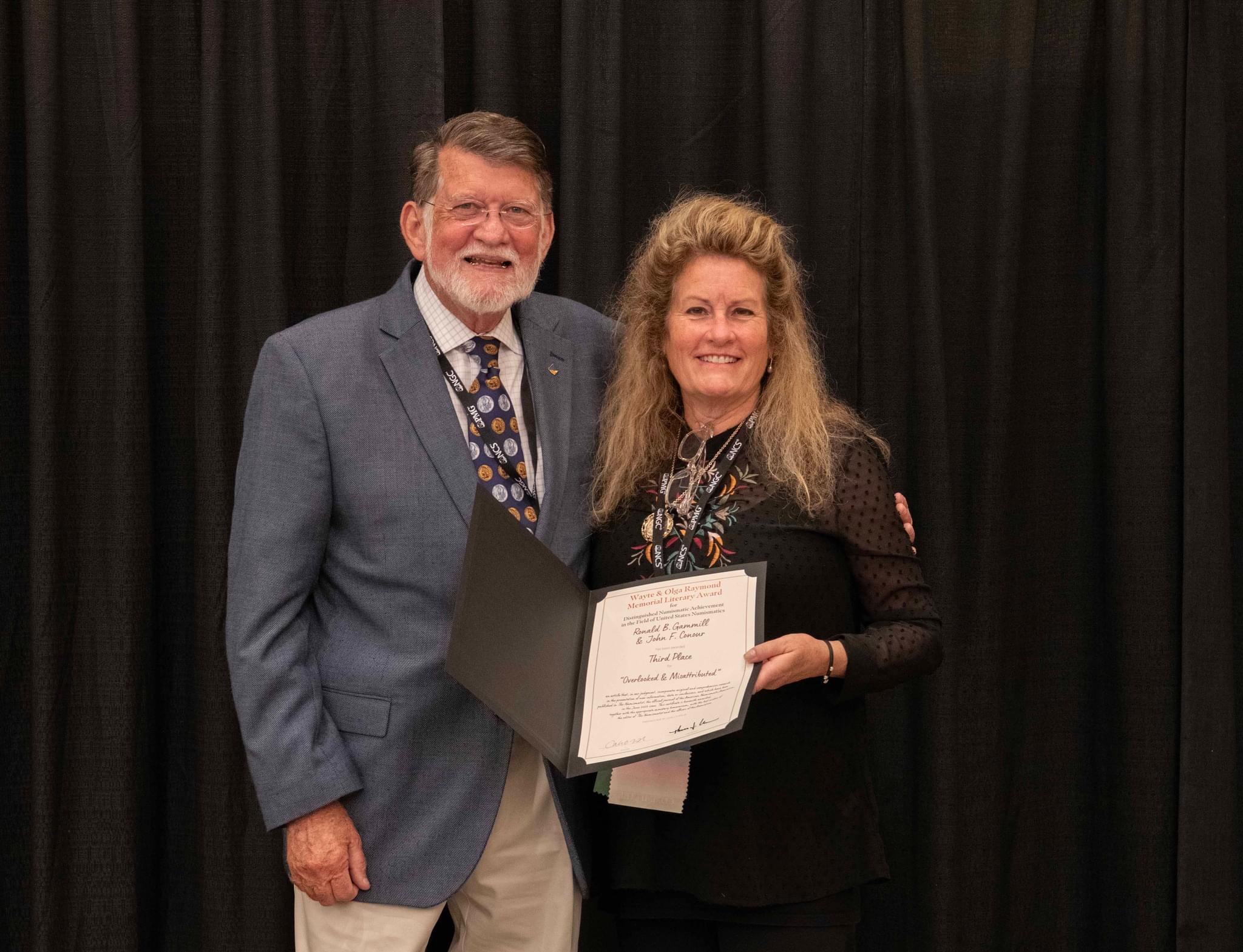
The Significance and Attribution of Lafayette Medallions and Medalets

John F. Conour and Ronald B. Gammill

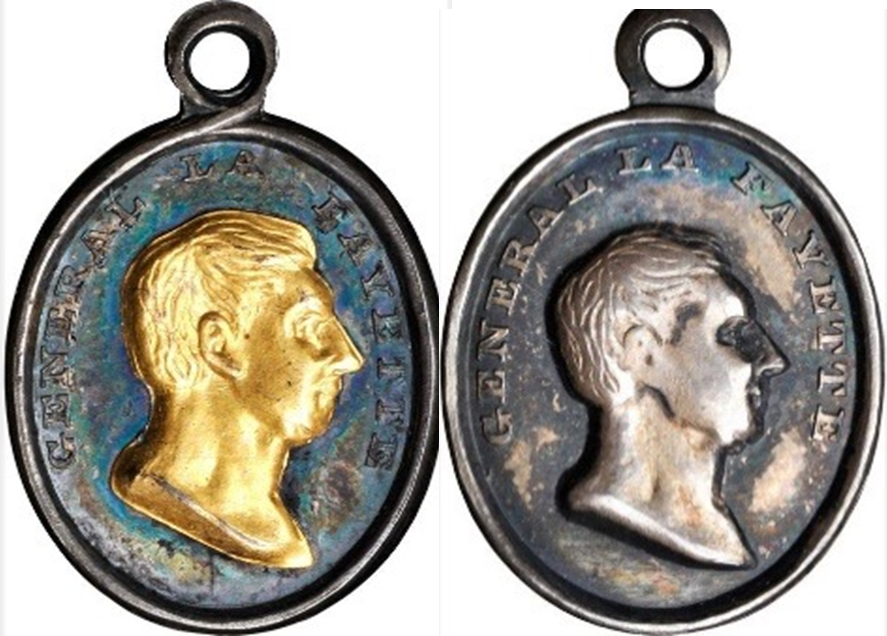
This presentation will establish the significance of the long-overlooked Oval Gold and Silver Lafayette Medallions of 1824 issued in celebration of Lafayette’s return visit to America. We will also address the confusion surrounding the appearance and attribution of the Washington-Lafayette Medalets and corresponding counterstamps of 1824. A host of other important Lafayette medallics issued around the time of Lafayette’s visit will be presented. Conour and Gammill will then discuss the current misconceptions as to their history and who did or did not sink the dies.

Tags: Charles Cushing Wright, Richard Trested, James Bale, Joseph Lewis, Robert Lovett, James R. Snowden, James D. Stout, Thomas A. Anners, Ash & Mason, Blanding Casts, Asher B. Durand, Cyrus Durand, Peter Maverick, Medals of Washington.

The next NNP Symposium will be on November 17th, 18th and 19th from roughly 10:00 AM to 7:00 PM Eastern time with speakers every hour and a half.

Newman Numismatic Portal

Washington University

St. Louis, Missouri

Oval Gold Lafayette Medallion of 1824
Oval Silver Lafayette Medallion of 1824
Washington-Lafayette Medalet of 1824
Obverse Washington Die Counterstamp on an 1818 Large Cent
Reverse Lafayette Die Counterstamp on an 1818 Large Cent


Figure 1.  1804 C-6, Manley Die State 4.5 Half Cent.

Those of you that are members of Early American Coppers (EAC) have seen the listing for both the Half Cent and Large Cent 2020 Happening Varieties at this years EAC Convention (April 30 to May 3, 2020) at the Marriott City Center in Pittsburgh, PA this year.  One of the half cent varieties in the Happening that caught my eye was the 1804 C-6 variety.  I remembered having this variety and thought I would retrieve it to see which die state I had.  I did remember that it was one of several coins from well know New York collector Vincent W. Alones.  Alones was a longtime hobbyist and ANA member.  Vincent W. Alones passed away at the age of 95 in 2012.  He was a World War II Navy veteran from Long Island, NY.  Vincent had his name published in the July 2011 issue of The Numismatist for being a 50 year member of the ANA. He was also an award-winning exhibitor who won an ANA Presidential Award in 1994 and the Medal of Merit in 1995. Vincent Alones attended every ANA Convention from 1952 to 2008!

Vincent Alones won over 200 prizes in numismatic competitions during his lifetime and was a long-time member of the Long Island Coin Club. His estate provided a large portion of Vincent’s amazing coin collection to be sold, in part, to benefit the Virginia Numismatic Association.

Vincent started collecting in 1934 and his collection contained many coins from major auctions such as the Anderson-Dupont Collection (1954), B. Frank Collection (1956), Farish Baldenhofer Collection (1955), B. Max Mehl (1942), and coins obtained from Abe Kosoff, Walter Breen, Empire, T. Weiss, and New Netherlands Coin Company.  What a list of numismatic notables.

The Virginia Numismatic Association sold Alones Collection in conjunction with its 54th annual convention  in September  2012 at the Fredericksburg Expo & Conference Center in Fredericksburg, VA.  Session I included between 250 and 300 lots of mostly copper coins and was especially strong in large cents.  I spend this brief introduction to Vincent W. Alones because if not for collectors of his character and generosity we, the current day collectors, would not be able to reach back in our history to gain further insight and motivation we enjoy assembling our collections and the history they contain and that can be shared with your fellow collectors.

The spiked chin 1804 half cents are a favorite of collectors and has been throughly studied and documented in numerous books and articles.   While the “spiked chins” range in rarity from R-x to R-Y, for the C-6 variety, there are 13 different but distinct die states.  and written about is a plentiful issue carrying a mere R-2 rarity rating.  However, what makes it interesting are the various die states for this issue that Ronald P. Manley has so exquisitely described in his book, “The Half Cent Die State Book 1793-1857”.  Some die states are quite common while others, not so much so. Obverse die 1, as it has been cataloged, was used with different reverse dies in striking several die marriages before something happened to change the face of the die and created the damage that gives the coins their nickname..A raised horizontal projection or “spike” protruding from Liberty’s chin, with a second smaller projection protruding from Liberty’s lips like a tongue. A series of curved parallel lines appear in the field in front of Liberty’s neck, from just below her chin to just above the drapery on her bust.  Various theories have been floated to explain the anomalies, with the most likely being that the die was damaged when a small threaded bolt fell onto it during a striking cycle, according to Walter Breen’s book on half cents.


1804 obv 2

Figure 2.  Obverse view of the C-6 variety obverse.

Obverse is the same as 1804 C-5 and 1804 C-7 but later in the progression.  The “Spiked Chin” is always found with clash marks at the throat and cracked through the tops of LIBERTY with this die pairing.

1804 6

Figure 3.


1804 24

Figure 4.


1804 17

Figure 5.


1804 8

Figure 6.

1804 1

Figure 7.

Each wreath branch has five berries..

Always found with a cracked revere.

All the T’s have missing or defective feet.

1804 13

Figure 8.


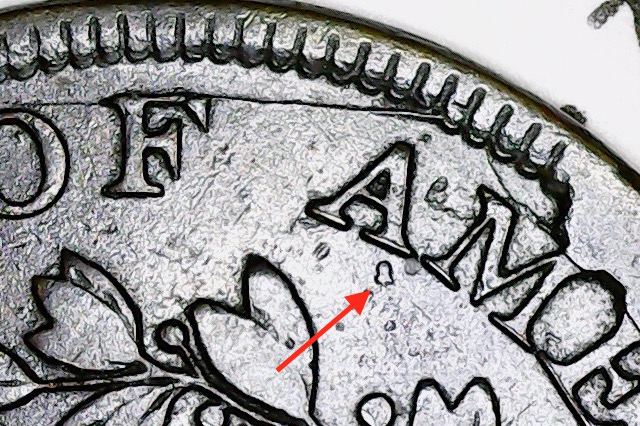
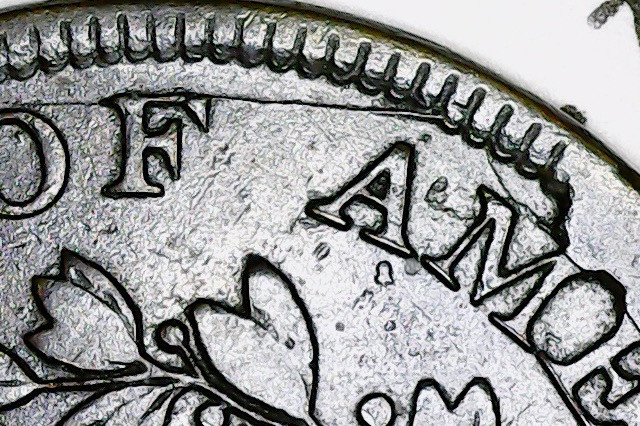
A patch of die rust is below the right foot of the first A in AMERICA.

1804 32

Figure 9.

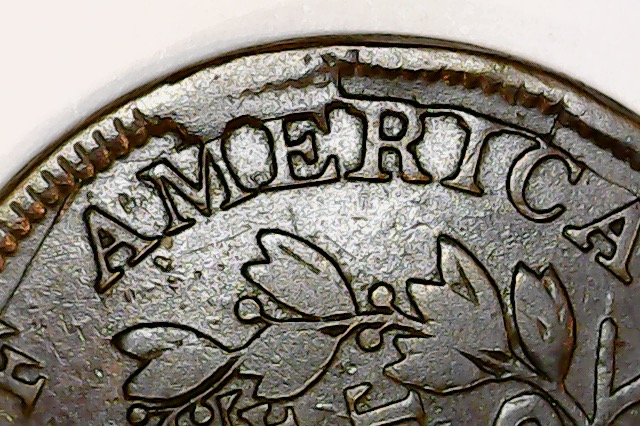
An engravers’ scratch extends from the right stem end midway to the second A in AMERICA.

1804 29

Figure 10.


A die flaw slants right from the top of T in CENT.

1804 31

Figure 11.


A tiny lump is between NI in UNITED.

1804 30

Figure 12.


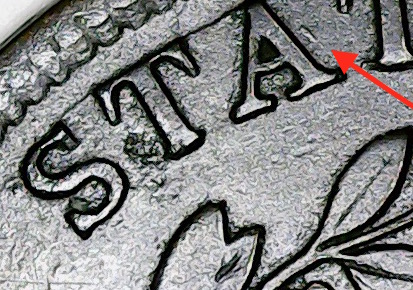
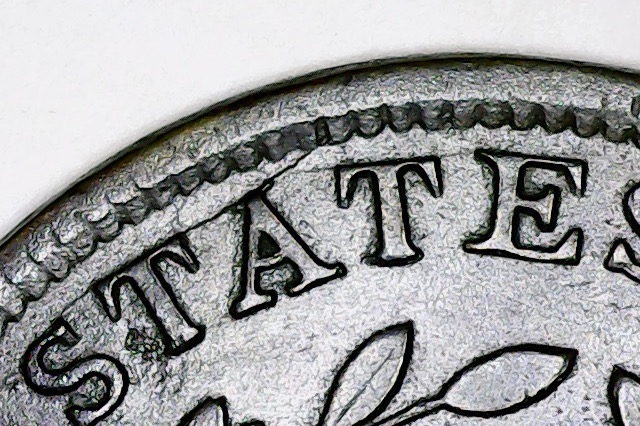
A short die scratch is found parallel to the right side of A in STATES….which eventually fades.

1804 12

Figure 13.

1804 41

Figure 14


1804 40

Figure 15.


1804 11

Figure 16


1804 9

Figure 17.