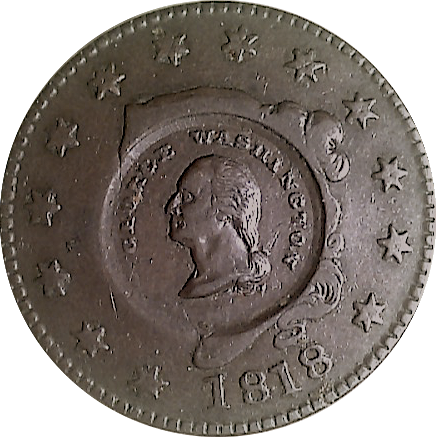
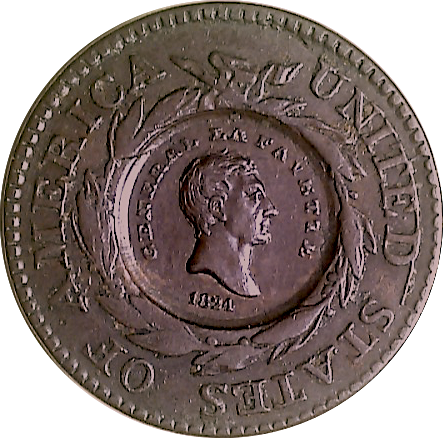
1818 (Newcomb-2) Washington-Lafayette Counter Stamp
The Washington-Lafayette Counter Stamp is one of the most famous and desirable counter stamps in American history. Rarely are these historically rich pieces seen for sale. For most Early American Copper connoisseurs, these rare pieces represent a culmination of rarity, history, beauty and always, always provide depth to a numismatic collection. Duffield reported that he was aware of the Washington-Lafayette counter stamp on 1817, 1818, 1822 & 1823 large cents. We are also aware of an 1807 half cent with this counter stamp. Current estimation is that the existing known population of these large cents is in the neighborhood of 12.
The dies were made by Joseph Lewis for his Washington – Lafayette Medalets. It is these dies that are neatly impressed into the above 1818 (Newcomb-2) large cent. This is an especially intriguing example since to my knowledge, it is only the second known example on the 1818 large cent issue and in this particular case, the host coin is a Newcomb-2 variety, which according to Robinson in ‘Copper Quotes’ (edition 2011), is an R-4. The close date (particularly the center ’81’), the away stars, and stars 3 and 6 pointing in between dentils making the obverse readily identifiable as Obverse 1. Reverse B is likewise readily identified by the heavy die crack above UNITED. Leaf positions (PC+, PR, SPC, & C-) which are totally consist with Reverse B, thus resulting in the Newcomb-2 assignment.
To our knowledge, the only other known example of an 1818 large cent with a Washington-Lafayette counter stamped has a very interesting pedigree and is housed (or captured as some EAC’ers might say) in a PCGS VF-20 holder. This specimen is a Newcomb-3 which is an R-3. The dies used to strike these two coins are somewhat similar. The obverse die for the N-3 (Obverse 2) has *6 pointing to left of the coronet tip and *10 star pointing up to the upper lobe of the hairbun. However, the most discernible difference in differentiating between N-2 and N-3 is the location of *1 and *13 with respect to the date (for an excellent discussion see, Wright, John D. 1992. The Cent Book. Litho Technical Services, Bloomington, MN 55431, pages 36 & 37).
This Washington-Lafayette counterstamps were made in honor of Lafayette’s 1824 to 1825 tour of America in which he visited all 24 states in the Union at that time. Interestingly, at the time of his visit, Lafayette was the last surviving Revolutionary War commander.
The dies used to produce this counterstamp were originally cut to strike tiny 14.5 mm medalets that were worn or suspended from a length of ribbon, or mounted on ornate pendants. All of these pieces are scarce to rare according to many. At some point these medal dies were used to produce counterstamps on various coins dated from 1807 to 1824. These counter stamped coins are of even greater rarity than the medals. The earliest coin used for the host that I am aware of is an 1807 half cent. The host half cent is in poor condition but the date is visible. Large cent examples are found on 1816, 1817, 1818, 1820, 1822, 1823 and 1824 issues. The counter stamp is also found on dimes of 1820, 1821, and 1822; half dollars of 1824; and a Spanish silver one and two real.
Counterstamped coins, such as the 1818 N-2, were made by noted medalist Richard Trested and his apprentice James Bale. The story most generally told is that while Lafayette was being entertained at the Mint during his visit to the United States about 1824, in compliment to Lafayette, each of which party was privileged to offer a coin on which the stamp was made from punches that had been prepared especially for the purpose. Another story is to the effect that during a procession in honor of Lafayette, coins bearing the counterstamps were thrown from one of the carriages to the crowds lining the streets to which the procession passed. There is no evidence that Lafayette visited the US Mint and distribution at a parade seems interesting but unlikely in our opinion.
The finest known example of this rarity on a large cent appears to be an 1820 issue that NGC has graded AU-58. This specific example is far better than the two examples in the May, 2004 Ford sale (lots 194 and 195). This clearly is the finest known example of this scarce and desirable counterstamp.
asdf
asdf
 Gammill Coin Gazette
Leave a comment