Feeds:
Posts
Comments

Archive for the ‘Gammill Numismatics’ Category

Coin collectors, old and new, as well as many non-collectors, often wonder these days whether the coins in their pocket (or modest collection) are worth more than their face or bullion value.  The following are basic factors that in general influence a coins value.  No rocket science here, just common sense.

How rare is that Lincoln cent I just found in the parking lot?  It’s for sure old because it has the wheat stalks on the reverse and those haven’t been around for almost 50 years.  Ah, my ship has landed….or has it!

People generally realize that the rarer a coin the higher the coins value. Of course the condition of the coin is most often also very important.  The exception to this would be a unique coin, i.e., one of a kind in which case condition takes a back seat.  Additionally, the common belief that the older the coin the greater its value is not always true.  The bottom line is 1) condition, 2) mintage (number produced), and 3) demand.  These are “in general” pretty good criteria to follow when you start to evaluate that parking lot find.  

Is the coin in good condition?  The better the condition the greater the value and thus the more it will bring in the marketplace.   The condition (strike and luster) and eye appeal of a coin contribute heavily to a coins value.  A coin that is in mint state condition could actually be worth a hundred times the same coin in a lower circulated grade.   If you don’t know how to grade coins, find a trustworthly dealer that can help you.  You also have the choice of sending it to a third party grading service such as PCGS or NGC.   But remember, knowledge is power and you want to keep the “knowledge card” in your hand.  The ANA sponsors excellent grading classes during the Summer Seminar Series each July.  The instructors represent the best in the industry.  Inaddition, the way the grading is taught keeps you in tune with the market and thus the ever changing commerical demands of the market.

If the coin is in nice condition the next question is, how many were made.  Is the coin rare or just a common date (which might be the reason you found it where you did) within the series.  Pick up a “RED BOOK” at you local bookstore, or just google “US Coin Mintage” and find out how many were made.  Low mintage usually means a higher price.  If you find a coin with a mintage less that 500,000 you probably  have a very interesting coin in your possession.  However, if they made 50,000,000 million, well, you probably don’t have anything of great value. 

Supply and demand!  In those series that are heavily collected, Indian Head Cents, Lincoln cents, Buffalo Nickels, Liberty Head Dimes, the key dates are always in demand….there just aren’t enough of the low mintage coins to go around and the prices stay high.  However, higher mintage issues cost a fraction of these other key dates and this is even true of the mint state issues. 

What about the idea of age, how old is the coin.  Is an older coin more valuable that a relatively modern issue?  No, just because a coin was made in the 16th century does not mean it is more valuable than a coin made in say 1972 (Lincoln double die).  It goes back to rarity, demand and availability.  There are many 16th century coins that can be purchased for less than a hundred dollars, or even fifty dollars.  There were just a lot of them made and they have surived over time. 

Once again, how many are available and what is the demand.  Those are the two big questions for those of us in the world of collecting.

A Coin is Worth More Than a Coin…When it is RARE and in DEMAND!
Read Full Post »

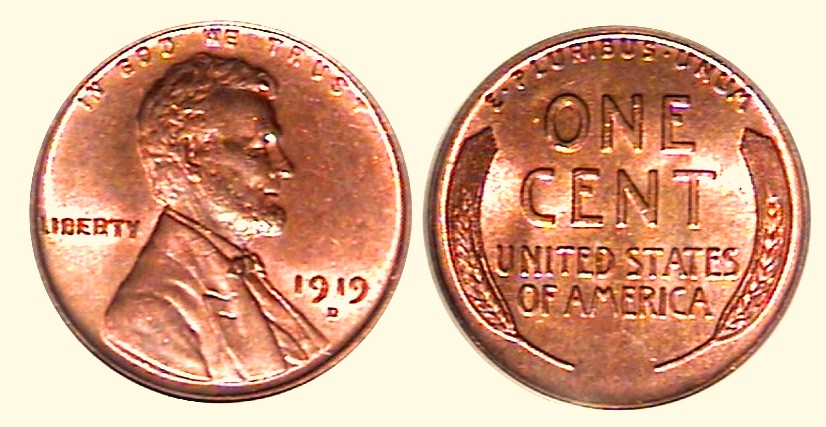
1919 D Lincoln Cent

Next year, 2009, we will celebrate the 200th Anniversary of the birth of our 16th President Abraham Lincoln.  In addition, 2009 will mark the 100th Anniversary of our Lincoln Cent.  Lincoln is remembered for his personal struggles and family tradgies he encountered during the civil war by most, none the less, he had a very colorful career as a self taught attorney prior to becoming our Nations President.  In the mid 1850s his cases focused almost entirely on transportation interests of river barges and railroads.   These were giants of industry at the time and Lincoln was in the middle of it all. There are several prominent cases during this time in which Lincoln demonstrated his skills as an attorney.  Such as, in 1851 Lincoln argued that as a matter of law a corporation is not bound by its original charter when the charter can be amended in the public interest.  His most famous civil case, which won Lincoln much notoriety, was the 1856 landmark Hurd v. Rock Island Bridge Company.  However, thought by many his most notable criminal trial came in 1858 in his defense of William Armstrong, a fellow who had been charged with murder.  Lincoln’s use of judicial notice that an eyewitness had lied on the stand) was a rare tactic at the time.  It is a very interesting story. 

Our 16th President was indeed a very colorful and brilliant gentleman and to continue to honor him in 2009 on our coinage is a continuation of our respect to his character and leadership during a challenging time of this great nation.

In 2009 the Lincoln Cent reverse design will change and feature a series of four different designs released every three months. Each of the designs will represent different stages in the life of Abraham Lincoln (see below).

  • Birth in Kentucky (1809-16)
  • Formative Years in Indiana (1816-30)
  • Professional Life in Illinois (1830-61)
  • Presidency in Washington DC (1861-65)

Additionally, the Secretary of the Treasury has the authority to mint and issue numismatic coins with the original composition of 95% copper and 5% tin and zinc.  Fantastic!

There will also be 500,000 Commemorative Silver Dollar issued to honor President Lincoln.  The design will be illustrative of the life and legacy of President Lincoln.

Both proof and uncirculated versions of the coin will be available from the US Mint from January 1, 2009 to December 31, 2009.

Starting in 2010, the reverse design will be changed once again to one emblematic of Lincoln’s preservation of the USA as a unified country as we continue to honor this Great Statesman into the future.   

The 2010 issue will permanently replace the Lincoln Memorial reverse used since 1959.


Thanks for reading.

Read Full Post »

The answer to the question is YES, a fellow by the name of Vinton G. Cerf, currently a Vice President at Google is widely considered by most as the father of what we know today as the internet.  Dr. Cerf lead the team that developed our governments communications network during the cold war era which then came to be what we know now as the internet. 

At Google he is responsible for identifying new enabling technologies and applications on the Internet and other platforms for the company.  Please use this link to Google to learn more about this extraordinary scientist.

In 2005, Dr. Cerf and co-inventor Robert Kahn received the highest civilian honor bestowed in the U.S., the Presidential Medal of Freedom.

These guys have meant a lot to coin collectors and most of us don’t have a clue who they are.  Roger Sibioni has written a nice paragraph or two on some of these early internet explorers that enable us numismatist to do what we do with such great ease.  It is well worth the read and if you are not familiar with the E-Sylum,  after reading this you might want to become a subscriber.

 Now we all know a bit more.

Read Full Post »

Civil War Tokens

THE RATTLESNAKE TOKEN!


Collecting Civil War tokens is an interesting pursuit just loaded with history of the Great War between the States.  Regular issues of US coinage was hoarded during the Civil War and this dramatically restricted merchants ability to make small change.  In response to this situation, many of the  merchants had tokens made to give out as change in their stores.  If you ordered the least expensive tokens you would receive a combination of two existing dies, usually of a Patriotic nature or similar to a US cent.  We refer to these tokens as  Patriotic Civil War Tokens


If on the other hand you had more to spend for tokens you could have custom dies prepared with specific information relating to your business (i.e. location, occupation, specialties, etc.) these are referred to as Civil War Store Cards.  These tokens are often refered to as Tradesmen Tokens.


Given the above information, it is not surprising that collectors in general classify Civil War tokens as either Patriotic or Store Cards (there are others we will cover later).  Now get ready; there were some 50,000,000 or more of these tokens issued!  Approximately 10,000 different varieties have been recorded! This area of numismatics represents an abundance of affordable small pieces of copper that represent a very important part of the fabric that makes this country what it is today.  There are almost endless ways of assembling Civil War Tokens (CWT) by variety or topic for the collector.   Want a history lesson of the early 1860’s…..this is a wonderful place to begin.


Patriotic tokens are anonymous, as mentioned above, struck from stock dies for general circulation. These tokens have patriotic themes – ARMY & NAVY, THE FLAG OF OUR UNION, LIBERTY AND NO SLAVERY, etc. – but some “Copperhead” tokens were issued with designs critical of the war, such as MILLIONS FOR CONTRACTORS/NOT ONE CENT FOR THE WIDOWS.


Store cards were made with their issuers and generally carry an advertisement for the issuers business.  One of my favors are the tokens bearing a mortar and pestle, relating to medicinal agents of the time.  However, other items like trunks, stoves, a stein of beer, animals and many more were used.  On the other hand, many show simply a stock die such as an Indian head, eagle, or patriotic theme.


In reality, cent-size copper tokens were first issued before the Civil War.  There are examples of issues as early as 1858 and 1861,  These pre-Civil War tokens are usually collected together with the genuine article due to the difficulty of confidently separating them and the long exiting collecting tradition. Some of the more recent catalogues do identify many of them as “non- contemporary” issues.

.

Now with that background for those not familiar Civil War Token collecting, lets get on to the main subject of this article, the “Rattlesnake Token”.   This token is appealing for several reasons but formost is its symbolism as far back as colonial times in this country( i.e. at least 1750 or so).  The rattlesnake was the favorite animal emblem of the Americans even before the Revolution.  Moreover, no one can misinterpret either the partial or full phrase,  “LIBERTY OR DEATH: DONT TRED ON ME”, found of the flags of 1775 along with either coiled, or full length rattlers decorating the sacred hand woven material this all resided on.


On the Obverse: The Union Must and Shall Be Preserved.


On the Reverse: “Beware”, shown above the snake with the date 1863 beneath.

This die marriage is 136/397.


The rattlesnake has been a favorite symbol of independence throughout America’s history. It was first adopted as a uniquely American ICON by early patriots such as Benjamin Franklin. The rattlesnake represented American unity. For example, individually, its rattles have no sound, but united, they can be heard by all. Moreover, while it does not strike unless threatened, once provoked, the deadly rattlesnake will never surrenders. 

Opponents of the Civil War were also known as “Copperheads”) and criticized Lincoln for refusing to compromise on the slavery issue.


The Civil War Token we are interested in falls into “Patriotic” series. The firebrand design of the Gadsden Flag serves as a reminder of the birth of our nation and the spirit that carried it to freedom. The bright yellow banner bears an ominous coiled rattlesnake with the warning “Don’t Tread on Me.”


Confederate iron rattlesnake waist belt buckle very similar to the one in Mullinax’s Confederate Belt Buckles & Plates book, expanded edition, page 114, plate 201.


UPDATES TO FOLLOW.


Read Full Post »

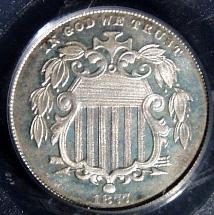
With a proof mintage of only 1,250, and no circulation strikes, the 1877 Proof Shield Nickel is by far the rarest issue in the Shield Nickel series. Highly sought after by collectors in high grade with attractive eye appeal for both Type Sets and the Series Sets. The coin illustrated is housed in a second generation PCGS holder, an item that has had the auction venues jumping of late.  The population of this coin is 134 pieces in PCGS PF 64 with 159 higher and a total of 372 in all grades.  A true numismatic rariety.

Read Full Post »

The term “Stand Alone Coin”, in the numismatic context, refers to a coin that is generally free from market swings resulting from economic, political or promotional occurrences. To be sure, this is the environment in which we live these days! This makes “Stand Alone Coins” an ideal investment vehicle, however, the projected rate of return is difficult to ascertain and actually, the best information on the potential return is gathered by looking at historical data to get a glimmer of future performance. However, as a warning up front, past performance does not necessarily guarantee future performance, and this statement should be taken very seriously by all interested in investing in rare coins.

There is a certain segment in the rare coin market that is often overlooked by most collectors, and to a lesser extent investors, that has often provided those who pursue it tremendous rates-of-return on their investment. We are talking about a segment consisting of coins that are critically important to the field of numismatics. These coins are pivotal within the denominational series they represent. We are talking about “Key Date” coins, a term every collector and investor alike is familiar with in numismatics. These “Key Date” coins are in fact, for the most part, “Stand Alone Coins” as well.

Why are these coins so critical to the numismatic market? It is a simple matter of supply and demand. Stand Alone Coins have never existed in great quantities and the demand for them has always been intense since the earliest days of numismatics. Furthermore, astute collectors and investors are more than willing to pay record prices for these rare coins because they establish the price by which all other similar coins are valued.

If purchased at competitive market price, “Stand Alone Coins” will meet the following criteria and have the corresponding advantages:

(more…)

Read Full Post »

« Newer Posts