Feeds:
Posts
Comments

Ira and Larry Goldberg’s auction of the Dan Holmes collection of Large Cents, in collaboration with Chris McCawley and Bob Grellman, will offer the large cent collector an opportunity to bid on a total of 68 NC varieties.  There are 55 NC varieties recognized by collectors and Dan was able to assemble 54 of the 55.  The one missing from his collection is the unique (1795 NC -5) which is located in the American Numismatic Societies Museum in NYC. 

In Dan’s collection of NC varieties there are 14 coins where there are duplicates.  Several of those NC varieties are of considerable interest and value.  For example, Lots 77 and 78 are examples of the 1794 NC-9, R7+.  Lot 77 is net graded Good-5 but the reverse vertical die crack is very weak (EDS, Breen state 1).  In the case of Lot 78, net graded About Good-3, the sharpness is slightly better and the reverse die crack is very strong indicating its LDS.  There are only four known examples of the 1794 NC-9 variety, two of which are in Holmes’ auction.  The census of these four examples are, 7-6-5-3.  The estimated value of these two lots is in the $20,000 range.  The VG-6 example was sold in February 2008 by Superior Galleries for $36,500.

Lots 129 and 130 offer two examples of the Jefferson Head 1795 NC-1, R8+.  Lot 129 is the “Unique” Thick Planchet Jefferson Head with Lettered Edge of 1793.   One of only three examples of the 1795 NC-1 and the only one struck on a thick planchet.  Graded by PCGS as Fine-15 and by McCawley/Grellman as Fine-12.  Estimated value for Lot 129 is $50,000.  Lot 130 is the thin planchet example of the NC-1 of which there are only two known examples.  Lot 130 grades as a Fair-2 with an estimated value of $20,000.  The second example has a grade of VF-20.

Lots 132 and 133 are also a pair of Jefferson Head NCs.  Lot 132 is the 1795 “Unique” Jefferson Head NC-4 (R8+) Thick Planchet Overstruck on a 1795 NC-1.  The coin is holed at the top of the head but is the second finer of only two known for the variety and grades Fair-2.  It is also unique that it is overstruck on an NC-1 thick planchet!  This varieties estimated value is $20,000 and UP.  This is truly a unique specimen.  Lot 133 is another “Unique” Jefferson Head NC-4.  This Jefferson Head is struck on a Thin Lettered Edge Planchet and grades Good-5.  The estimated value of this NC-4 is $30,000.

There is also Lots 394 and 395.  Lot 394 features an Outstanding 1800 NC-4 EDS.  It is the finest known of eight examples in all die states.  It grades EF-40 and is the Noyes plate coin.  Estimated value is $20,000.  Lot 395 is the 1800 NC-4 in MDS and grades Fair-2.  Estimated value is $4,000.

A complete listing of the NC varieties is listed in the table below.  It offers a unique opportunity for the large cent specialist.

Table:  A listing of the NC varieties in the Dan Holmes Collection being offered by Ira and Larry Goldberg on September 6, 2009.

Lot

Year

NC #

Rarity

Grade

Estimated  Value

Realized (+15%)


4

1793

NC-1

R8

BS1+

$10,000

 $28,750

7

1793

NC-2

R8+

PCGS Fair 2

$150,000

 264,500

8

1793

NC-3

R8-

PCGS G4

$150,000

 218,500

15

1793

NC-4

R7+

G6

$10,000

 27,600

17

1793

NC-5

R8+

EF45

$1,000

 6,325

25

1793

NC-6

R8

G4+

$20,000

 40,250

29

1794

NC-4(S-17b)

R8

AG3+

$10,000


34

1794

NC-7(S-20a)

R8+

G4

$10,000


40

1794

NC-8

R8-

F12

$20,000


41

1794

NC-11

R8

VG8

$20,000


57

1794

NC-1

R7+

G5

$10,000


64

1794

NC-2

R8

VG10

$20,000


70

1794

NC-10

R8+

F12

$20,000


72

1794

NC-5

R8

AG3

$20,000


77

1794

NC-9

R8-

G5

$20,000


78

1794

NC-9

R8-

AG3

$20,000


106

1794

NC-6

R8

F12

$30,000


115

1794

NC-3

R8

F12

$20,000


122

1795

NC-2

R8

AG3

$10,000


123

1795

NC-3

R7

AG3+

$5,000


129

1795

NC-1

R8+

PCGS F15

$50,000


130

1795

NC-1

R8

Fair 2

$20,000


132

1795

NC-4

R8+

Fair 2

$20,000


133

1795

NC-4

R8+

G5

$30,000


149

1796

NC-1

R6

VG7

$4,000


150

1796

NC-1

R6

VG8

$5,000


156

1796

NC-2

R7

VG10

$10,000


159

1796

NC-3

R6+

VF30

$20,000


160

1796

NC-3

R6+

VG10

$8,000


169

1796

NC-4

R5+

F15

$10,000


170

1796

NC-4

R5+

VG8

$4,000


188

1796

NC-5

R7

AG3

$4,000


201

1796

NC-6

R8

AG3

$10,000


205

1796

NC-7

R8

PCGS Fair 2

$20,000


208

1797

NC-1

R7

G6

$7,500


218

1797

NC-2

R6

VG8

$3,000


219

1797

NC-2

R6

VG10+

$5,000


220

1797

NC-3

R6-

G5

$2,000


221

1797

NC-3

R6-

VG8

$3,000


236

1797

NC-8

R8+

VF20+

$25,000


240

1797

NC-7

R8+

VG7

$25,000


243

1797

NC-6

R8

G4

$10,000


248

1797

NC-4

R8-

AG3

$10,000


258

1797

NC-5

R6

G6

$2,000


259

1797

NC-5

R6

VG8+

$4,000


283

1798

NC-1

R7+

AG3

$5,000


286

1798

NC-2

R7+

VG8

$15,000


287

1798

NC-2

R7+

VG8

$20,000


348

1799/8

NC-1

R7

F12

$50,000


356

1800/1798

NC-6

R6+

F15+

$10,000


357

1800/1798

NC-5

R8-

VG10+

$15,000


367

1800/179

NC-1

R8-

VG10

$15,000


368

1800/179

NC-2

R6+

VG7

$3,000


369

1800/179

NC-2

R6+

VG8

$2,000


377

1800

NC-3

R6-

VG8

$1,500


394

1800

NC-4

R7

EF40

$20,000


395

1800

NC-4

R7

Fair 2

$4,000


407

1801

NC-1

R5+

F12+

$5,000


415

1801

NC-2

R7

F15

$15,000


416

1801

NC-2

R7

BS1+

$1,000


417

1801

NC-5

R7+

AG3

$10,000


424

1801

NC-4

R7

VG8

$5,000


427

1801

NC-3

R6+

VG10

$5,000


438

1802

NC-1

R5+

G5

$500


439

1802

NC-1

R5+

EF45

$15,000


445

1802

NC-2

R6

VF25+

$10,000


493

1803

NC-1

R5+

VG7

$1,000


494

1803

NC-1

R5+

F15+

$7,500


Congratulations Dan, you have managed to accomplish something that all who love and collect large cents can share and enjoy with you into the future.  Your perseverance over the last 35 years has resulted in an historical “first” for the coin collecting community on the whole, and particularly, for large cent collectors everywhere.  To further distinguish your accomplishment, you compiled your collection by what we will call the “old school approach” of untiring patience in your search, meticulousness in your purchases, and all done with an “eye” for unwavering quality in your choice of copper.  Your assembling the most complete set of Early Date US Large Cents in history is an event that will go down in numismatic history as one of the foremost events in our hobby.   

Not only has Dan brought together all 302 Sheldon varieties in the early date years (1793-1814) in a single collection, but even more remarkably, he has managed to couple that with bringing together all 53 of the NC (noncollectible) varieties as well.  Dan was able to obtain all of the noncollectible varieties but one.  Through the generosity of the ANS, they have loaned to Dan that single unique coin, the 1793 NC-5, through his September auction to make it possible to display, and for collectors to view, a complete set by Sheldon number of United States Early Date Large Cents for the first time.   This display contains all 355 varieties including the NC varieties of this remarkable era in our Early American history.  What an amazing triumph!

The extent of Dan’s accomplishment has further been amplified by Bob Grellman when he noted that there are probably two dozen coins in this early date large cent collection whose rarity exceeds both the 1804 dollar and the 1913 Liberty nickel!!  Another remarkable accomplishment!

And, there are over 50 coins listed as finest known for the variety, or condition census pieces including many of those described below. 

The sale will take place September 6, 2009, at the Crowne Plaza Hotel in Beverly Hills at 1:00 PM with auctioneers Larry and Ira Goldberg in collaboration with Chris McCawley and Bob Grellman, The Copper SpecialistThis continues to be a phenomal team for bringing high quality large cent auctions to the cutting edge for both collector and investor.  We owe these gentlemen a great deal of gratidue in bringing us these landmark events.  Thanks to you and you hard working staffs gentlemen! 

We will mention a few highlights of the auction to further heighten your interest.  We will give you the PCGS grade as well as McCawley and Grellman’s grade (The Copper Specialists/EAC grade).  

Let’s begin with Lot 128, the legendary 1795 Reeded Edge Sheldon-79.  This Holmes coin is the finest of 8 known examples (R7+).  Even through the grade assigned by PCGS is only VG-10, the Reeded Edge is clear and strong with the exception of a small area over the S-OF-A where it is weak or missing.  McCawley & Grellman give the coin a VG-10 designation.  To help put this particular coin in perspective, a G-4 with heavy wear brought $402,500 (lot #1143) in the Nov. 20, 2008, Bowers and Merena auction in Baltimore.  What will be the final hammer for this exceptional treasure, one of the most famous coins in the collection?

Probably considered to be the most valuable coin in the collection is Lot 352.  This is the extraordinary Mint State 1799 Sheldon-189 (Normal Date).  It is the only Certified Mint State coin of that year.   It has been graded MS-62 BN by NGC.   It is the superior coin for that year by a wide margin, the runner-up being a VF-30 example housed in the ANS Museum.  Catalogers McCawley & Grellman give the coin an AU-55 designation.  This is the “must-have” coin for anyone assembling a registry set of mint state large cents!

Lot 3 is another amazing coin.  It is the second finest 1793 Sheldon-2 Chain America graded MS-63 BN by PCGS.  It ranks as an R4+.  This copper has incredibly well defined hair detail and magnificent surfaces beaming with luster.  McCawley and Grellman assign this coin a grade of AU-55 due to the light friction on the highest points.

Lot 5 is another Chain America, the 1793 Sheldon-3, which is the Levick Plate Coin.  It is an R3- and graded MS 63 BN by PCGS.  McCawley and Grellman assign this coin a grade of AU-50+. 

Lot 7 is the Unique 1793 Strawberry with One Cent Centered, NC-2, R8+, graded by PCGS as Fair 2.  This is the Levick-Crosby Plate Coin. McCawley and Grellman assign this coin a grade of Fair-2+.  An extraordinary coin!

Lot 8, also a 1793 NC-3 Strawberry Leaf Wreath Cent with the ONE CENT High is one of only three known and is referred to as the “Common Strawberry”.   PCGS graded this coin as Good-4 with which McCawley and Grellman  concur.  The finest known example is a VG-7 (EAC grade) which sold for $862,500 as lot #51 in the January 5, 2009, Stack’s auction in Orlando.  This set a record  price paid for a large cent.  Will it stand or fall during the Holmes auction?

Accordingly, in a single collection, Dan has assembled two of the four known examples of the Strawberry Leaf Wreath Cent.

Lot 9 is a Prooflike 1793 S-5 (R4) Wreath Cent with Large Date and Liberty.   This is simply a near flawless Wreath Cent.  The coin is sharply struck and has reflective prooflike surfaces.  PCGS graded this coin MS-65 BN while McCawley and Grellman assign it a grade of MS-63 prooflike.  NGC had graded the coin as Specimen-65 BN.  This is simply another amazing coin in Dan’s collection.  Auction estimates are $150,000-UP!

Lot 79 is yet another spectacular and popular coin for the large cent collector.  It is the attractive high condition census 1794 Sheldon-48  (R5) Starred Reverse graded by PCGS as VF-30.  A very rare coin indeed in this grade!  McCawley and Grellman assign a grade of VF-25.  In Dan’s example, all 94 stars are clearly visible and reflect the quality of this great collection.  Someone will walk away with a pristine example of this popular variety.  Once again, auction estimates are $150,000-UP!

Lot 1 is the American Classic 1793 Sheldon-1 (R4) Chain Ameri. graded by PCGS as AU-58.  This coin represents one of the finest known of this variety.  Graded AU-55 by McCawley and Grellman, this is a true American Classic.

Lot 24 is the Finest Known Bisected Obverse 1793 Sheldon-14, a R5 and residing in an AU-53 PCGS holder.  McCawley and Grellman give this coin a grade of EF-45.  With an estimate of $100,000 and UP, given the exquisite nature and rank of the coin, this is surely a figure which will be exceeded.

As we continue, Lot 31 is another remarkable mint state large cent.  This lot is the lustrous 1794 Sheldon-18b, Head of 1793 with Edge of 1794 and is a R4.  PCGS graded this coin as MS-63 (tied for the finest they have graded) whereas McCawley and Grellman assign a grade of MS-60.  Estimated value for this coin is $100,000.

Lot 74 is the Finest Known 1794 Sheldon-45 (R5+), and the finest by a wide margin.   There is no roughness or planchet flaws on this coin which is from the Oswald group of mint state early dates.  PCGS graded the coin MS-65 RB, and McCawley and Grellman concur.  An absolutely beautiful specimen with an auction estimate of $100,000 and UP.

Lot 95 is a Gem 1794 Sheldon-59 (R3-), another Oswald coin graded MS 66 RB by PCGS.  McCawley and Grellman give the coin a grade of MS 65+ and note that it is certainly one of the finest 1794 cents of any die variety.  An incredible gem in all respects as well as being from the famous Oswald collection.   An auction estimate of $100,000 and UP.

Lot 101 is a Choice Mint State 1794 Sheldon-64 with Missing Fraction Bar, graded MS-64 RB by PCGS with an R5- rating.  McCawley and Grellman assign a grade of MS-63 to this choice steel brown coin with ample mint red color remaining.   Another coin with an auction estimate of $100,000 and UP.  Surely a true rarity with a PCGS population of 1 and none finer at PCGS for the variety.

Lot 185 is a Gem 1796 Draped Bust Sheldon-110 with an R3+ rating and graded MS-66 BN by PCGS and MS 65 by McCawley and Grellman.  Tremendous coin, possessing highly lustrous steel brown surfaces which have eloquently faded from the underlying mint red color which still remains strong in the protected areas.  An incredible gem which makes the large cent enthusiast gasps for breath and weak at the knees.

Lot 531 is the Unique Certified Mint State 1804 Sheldon-266c Large Cent graded MS-63 BN by PCGS with an R2 rarity rating.  This is the Sheldon Plate Coin.  McCawley and Grellman assign a grade of AU-58.  It is worth reading the description of this coin to understand the disparity in grade.  In any event, this is the finest known in both census lists.  This coin is a true prize for the most discerning collector of Early American Coppers.

Finally, also offeredd in this sale is the Unique Sheldon-Holmes Color Set.  This set consist of 6 Colonials and 60 Large Cents assembled by Dr. Sheldon and sold intact to Dan in 1976.   Auction estimate is $20,000-UP.  

We all eagerly await September 6, 2009 to learn the outcome of his historical sale.

We also wish Dan the very best and look forward to the remaining three sales in 2010.

Instructors: William Shamhart, Jr., Charles Browne, Lane Brunner, John Dannreuther & John Albanese

Week of July 4, 2009

If you aren’t familiar with the five names above, you should make a concerted effort to find out who they are and where you might meet and learn from their years of experience in numismatics. These gentlemen have a strong background in numismatic research, the marketplace, pricing and “grading” some of the most famous collector coins that have appeared in the market during the last 20-30 years. Of course, these were the gentlemen who taught the ANA’s Advanced United States Coin Grading and Problem Coins class out in Colorado Springs during the second session of this year’s ANA’s summer seminar series.

Bill Shamhart has been teaching advanced grading out at the ANA during the summer seminar series for a number of years and always brings along an “all star” roster of graders, numismatic experts and innovators in the hobby. Of course, Bill heads up the class and is a demanding mentor with the students’ best interest always out front. He is nothing less than a consummate professional whose philosophy is deeply seated in education.

Charles Browne is likewise a most respected PCGS grader and summer instructor with magnificent grading skills and a more than unique ability to explain the subtlety between that PF 66 and PF 67. Charlie also has a very enjoyable personality which enables him to readily share his strong fundamental understanding of market grading and the market place. He also has a mature and profound knowledge of the field of numismatics.

John Albanese, as most of you know, is the president of CAC. He was also one of the co-founders of PCGS and founder of NGC. He is a soft-spoken individual who is easy to engage and discuss grading and answer your questions. He is a man of many interests and seems to be one of the few who are able to see the “big picture” in the “collectibles space”. What an opportunity we had to have him there as an instructor for the week! It was a unique occasion to learn firsthand his insight into creating that little green “CAC” sticker. In addition, we benefited from his one-on-one instruction about grading which was an experience in itself. He was indeed, as they all were, splendid gentlemen with education at the top of their agenda.

Dr. Lane Brunner has served several positions with the ANA. Lane has a sharp and critical eye when it comes to grading high end coins and spotting coins that have problems of every description. His natural teaching skills were evident in our one-on-one examination of coins and explanation of problems that were present on many of the coins.

Finally, there was John Dannreuther, one of the co-founders of PCGS, a well-known world class researcher, author, consultant and rare coin dealer. John was just a wealth of information and enthusiastically shared his personal experiences in the business, as well as, some of his unpublished results regarding the minting process and in particular about proof coinage. His attention to detail during our one-on-one exercises was truly informative. John is currently working on his opus on proof gold coins and gave an excellent lecture on the production of proofs. What a wealth of information!

John, or JD as we learned to call him, rounded out a particularly unique gathering of instructors of exceptional caliber for our one week course.

All of these fellows have been around the business for a while (sorry for that guys), but as I am sure Bill would say……’the truth sometime hurts’.  These gentlemen are to be applauded for donating their time and energy so their students will not only be better at grading and detecting problem coins, but will also continue the generous giving of time and energy to numismatics through their example.

These instructors have seen, and in fact, been part of a lot of the change we have all seen during the last twenty years or so in our hobby. Their accomplishments range from the founding of the two most successful grading services and subsequent innovations, such as CAC, participating in numismatic service organizations, publishing articles, reference books and teaching.  Finally, they have been successful dealers who have prospered through ethical practices and survived the chaotic markets that occurred during the late 70’s and early 80’s.

From a historical perspective, these gentlemen’s mentors and current colleagues are among the greatest names in 20th century US numismatics.  I am sure that in future years, all the students in this class will delight in the fact that they sat in the room with these men for a week and were able to discuss the timely developments of grading, the coin market itself and contemplate the future of our hobby.

Now some comments about the class and its content.

There were twenty five students in the class, including one YN. We had five instructors for almost every exercise we conducted with one-on-one follow-up. The line of attack in the class was simple: we were to look at and evaluate as many coins in 5 days as possible, and then be able to gain a consensus within a group setting about the grade of those coins. I think we saw most US type coins (in copper, silver and gold) and in grades from AU 58 to MS 68 as well as a good number of proof issues.

Not stopping with the grade, you had to determine the method of manufacture (mint state or proof), color designation for copper, other designations such as PL, DMPL, cameo, ultra cameo, FH, FBL, FSBs, FS, as well as, whether the coin had been lightly dipped (and thus graded) or harshly dipped and a “no grade”, cleaning (heavy vs light hairlines), re-colored or doctored to cover scratches or spots….and so own. All the coins were either PCGS or NGC to the best of my recollection.

We broke up into five groups with one instructor assigned to each group. Then the fun began.  “Number you papers from one to thirty” came the directive from one of the instructors. Another instructor might tell us that we have 30 seconds to inspect each coin and then must pass it to our neighbor. They reminded us to go with our first impression using only the naked eye and then if you see a problem use your loupe. A loupe was also appropriate for the smaller coins. It seemed as if we were off to the races…and in fact we were!

Coins were passed around the group; you recorded your grade; and after everyone had graded the coins, we begin an in-depth evaluation of the coins. The objective was to arrive at some consensus regarding the grade within the group. All the while, we were getting feedback from our table instructor in the way of questions, comments and tips such as, you might want to look at that coin one more time (since you clearly missed something the first time).  The greatest learning tool was in the effort to gain consensus regarding a grade.  This was the process that exposed everyones thoughts about  the grade of the coins and thus provided the forum for disussion with the each other as well as the instructor.

At first, it was hectic but as that first day progressed I think most of us fell into a rhythm that at least helped everyone get to the second day. Then it started all over again on day two.

We were looking at a lot of different coins and were processing a lot of information in a very short period of time. In the first couple of exercises the grade spread within a given group might be from AU 58 to MS 65 or higher.  The objective of the class was to narrow that range down to the correct grade, or to be at least only one point away. Despite the hectic nature of the process the composure and positive instruction from the instructors resulted in little anxiety associated with the process after the first day. We were now on a steep learning curve and had nothing but critical information to gain. This realization, I think, was a big turning point in the class. Now, we had nothing to lose so to speak, but everything to gain. So listen and learn!

As the week progressed, each groups’ consensus grade became tighter and we also gained a much better understanding of A, B and C coins within a grade.  This is something John expanded on with regard to certified coins getting those little green “CAC” stickers.  

All in all it was a great week and is among the strongest classes I have seen the ANA summer seminar series offer in many years.   There were several people that signed up for the class next year before leaving Colorado Springs at the end  of the week.  That says an awful lot about the instructors and class content.  I don’t know of another place where you could gain this type of information from a fine group of experts.  I might also mention, there were several students in the class that had taken the class in previous years (as in last year).

If  you have the opportunity and are interested in grading ,be sure to look into this class.  You must have completed the Beginning and Intermediate grading classes before you can get into this advanced class. 

Remember: Eye Appeal and Luster are the two things that your eyes see first when looking at a coin and thus represents that critical first impression.  Eye appeal and luster are the top factors being considered in market grading and thus pricing.

We were constantly reminded that with market grading, eye appeal adds a little, but forgives a lot.

P1010404

In the July 6th (2009)  issue of Coin World Steve Roach wrote an interesting article entitled, “Is Old better than new? Age of slabs plays pricing role“.  This is a very informative article which suggests that in some cases because of the more conservative grading practices at PCGS and NGC in the early days, that coins in their old holders might be under-graded by subsequent market standards and thus would be a prime target for a nice profitable upgrade.  Over the years this has happened numerous times to be sure.  Steve gives several examples in his article (p. 46).

P1100222_edited

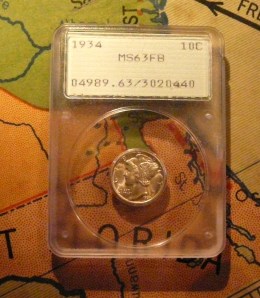
An Example of one of the early PCGS Holders

There are a couple of aspects about these “old slabs” that need a comment or two that were not mentioned in Steve’s article.

It is common knowledge that this has always been a  hot area for the crack-out artist. There have been a lot of these early graded coins which have been cracked out, received an upgrade, and thus brought more money.  But just as likely, there were probably coins that were over-graded!  What happened to those coins?

In spite of this earlier point in time, let’s be realistic.  Considering the bull market we have seen in rare coins during recent years, it is probably better to face reality and realize that most of those coins in the “vintage” holders have likely been inspected by the crack-out artist who are expert graders working for the larger dealers (who see such a huge volume of coins that the average collector can’t even comprehend) and auction houses.  Therefore, if you come across one of these old holders you need to ask the question, why is it still in that old holder!  Was it because no one thought it would upgrade, or was it over graded to begin with while grading standards were being established?  Likely, there is a very good reason the coin in that older holder is in its “final resting place” (the vintage holder).  You must realize that the day after they started slabbing coins, someone starting cracking them out and resubmitting them hoping for better grades; essentially taking advantage of the subjective nature of grading.  And as we all know, that crack-out process continues to this day and we don’t have to limit the crack-outs just to old PCGS or NGC  holders.

The bottom line remains, you have to be able to grade the coin and not make a judgment about grade on whether it is in an old holder.  Certainly, don’t draw any firm conclusions about whether it has been under-graded  just because of the holder and when the coin was graded.  All this despite the changes in grading standards we have incurred over the last 20 or so years.

NGC Holders with Black Inserts ARE VERY COLLECTIBLE!

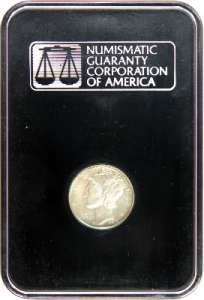
Now, there is another aspect to these old holders, particularly early NGC holders, that one must consider, i.e., the collectability of some of these very early holders.  For example, NGC started out on day one putting their coins in holders with a black background…..that only lasted about three days before it was discontinued probably due to negative market feed back and the fact, the holder simply didn’t have nice eye appeal, particularly for copper coins.  Thus, NGC coins (see below) in these old black holders are quite collectible and often can be valued at multiples of the coins they contain.

NGCBlack193910cbackNGCBlack193910cfront


The above photos came from the following link which gives a great deal of information regarding these collectible NGC slabs.  Thanks to Lane Brunner for pointing this area of collecting out to Gammill Numismatics, LLC. http://forums.collectors.com/messageview.cfm?catid=26&threadid=727096 


Conclusion:  It’s still the same old advice…..buy the coin, not the holder…..unless you have found an old NGC “collectible holder“. 

This is probably new information to many collectors, but none the less, gives you something else to be on the lookout for when looking in dealers’ showcases or someone’s personal collection.  You may be able to tell a fellow collector that the coin in that old holder isn’t of any great value but the holder, well,  is worth a lot!

I guess a green CAC sticker on one of these early black NGC holders would really be a keeper for a collection.

Think thrice: is the coin under-graded, over-graded or is it in a collectible slab (holder).

 AM23507536-oz

As the economy continues to struggle with rising unemployment numbers (heading toward 10%), tight credit for small businesses, bankruptcies and housing foreclosures increasing 15% in the first half of 2009, it should be no surprise that we are also seeing the activity of the coin collecting community shift their priorities.  With less disposable income we are seeing a drop in attendance and purchases by collectors at both the local and national level at both shows and auctions. Additionally, this economic down turn has hit collectors at all financial levels.  These are certainly not surprising results, but the question a lot of dealers and collectors alike are asking is: how long will it last? 

Many dealers are traveling less (particularly between coasts) due to slow retail and wholesale sales which are primarily due to the factors mentioned above, as well as, the lack of fresh material and the presence of what are referred to as “C” and “D” quality coins on the floor.  Or, to say it another way, too much of what everyone has already seen time and time again.  Dealers are relying more and more on internet transactions to get rid of these less than desirable coins while looking for the more desirable “A” and “B” coins, and in particular those coins that have the new little green “CAC” (Certified Acceptance Corporation) sticker affixed.  

Note, the “C” and “D” coins that are selling for discounts are not good collector or investor coins for your portfolio!    If dealers and collectors are trying to get rid of this material now, they will be trying to do the same thing in twenty years.  Quality (often referred to as eye appeal) is the leading factor that dominates market value!  

It is not surprising that a number of collectors out there have slowed down, or at least put things on hold for a while.  There are also a number of collectors and dealers that are either being forced to sell their collections to make ends meet; or, they are just becoming disillusioned by the current rare coin market, jittery economy and few positive signs of a timely recovery. 

There is also a strong desire by everyone in this collectible/ investment space to establish the value of their numismatic portfolios.  Of course value is always based on quality, availability and demand, and in a down market, the inferior examples in a specific grade are just going to sit and sit and sit!  In this market, only the top tier coins, i.e. the “A” and “B” examples in any given grade are going to be the coins that will move, and probably move at a premium independent of tier price.  Likewise the more common issues are going to be less desirable and will suffer due to the lack of demand for such ordinary items.  Add to this the overall movement of the world economy and this becomes a complex issue unless you are holding bullion (for which there are daily prices, and liquidation is efficient and has a well defined mechanism).

For some collectors who have been able to put themselves in a strong cash position, this is an excellent time to purchase coins if the right gems emerge.  For example, the recent sell of the Adams-Carter Class III 1804 dollar brought half a million dollars less than it would have reportedly brought a year ago due to the current recession.  This rarity sold several months ago at the CSNS show in Cincinnati.  It sold for $2.3 million (including the buyer’s premium) and was considered by the buyer at that time to be a bargain.  Time will tell, but my best guess is that this coin will recover nicely from the current down turn simply because it is a “true rarity“.  A true rarity is important for everyone to understand vs.  series rarities such as the 1909 S VDB.

In the early part of this recession, it seemed as though the casual (new) collectors began to disappear as the economy tightened up.  However, at this point, with the continuing problems on Wall Street, Main Street, General Motors going in and out of Chapter 11, CIT on the brink of insolvency, credit card debt, real estate debt and increased home foreclosures, we find that a lot of people who thought they were insulated from a fragile economy simply are not.  Of course Bernie Madoff made us all acutely aware of the criminal nature of some people and how cautious we all should be in the current environment with all financial investments.  Thus, there seems to be a slow methodical breather being taken by the collector base, as well as investors, until things become a little more upbeat, i.e. employment numbers dramatically improve for starters.

Remember, it started with the causal collector, then moved to the more dedicated collector and finally to the financially capable and steadfast collector.  Caution rules the moment for most.  At present, the biggest buyers of coins are coin dealers! 

Another important realization is that a price correction is taking place in the numismatic marketplace just as it has in so many other parts of our economy.  Of course we have the same problem as the other markets and that is, we don’t yet know where or when we will (or have) reach the bottom, what the recovery will look like and finally the time line of that recovery.

There are areas in this market that are doing better than others.  For example, early copper collectors seem to be holding up their area of collecting, while Morgan Dollars (particularly the common dates) and some of the more common early commemoratives are weakening.  Indian Head Cents and Lincoln Cents are somewhat slow.  Early Type (“A” and “B” coins) seem to be holding their own due mainly to their rarity due to scarcity.  This of course provides a nice buying opportunity if these are areas of interest to you and cash is available.  So, what do you buy now with confidence that your investment is sound in this down market?  You buy “A” and “B” coins that are rare due to scarcity and are always, for these reasons, in high demand.  Look for that “CAC” sticker or work closely with an experienced rare coin dealer to help you make these decisions.

The collectible and rare coin market has maintained its strength longer than most investment vehicles.  At first, it looked like rare coins were the ideal hedge against what was happening in the stock market.  However, sooner or later, just as with all bubbles, it has been forced to give back some of that rapid growth seen in the past three to five years.  There has been a lot said about foreign vs US money coming in from all over the world to purchase rare coins.  Now we see the effect of that world economy and realize the reality and consequences of what is now a world market in rare US coins, controlled by an impartial and slashing world economy.  

How long will it last?  It will last until we start seeing positive job reports at the end of every week for starts!  Look for that first and then formulate the next question!

When will collectors/investors from all positions and skill levels feel comfortable enough to re-enter the coin market once the economy begins to gain positive momentum?

eagle

There are reportedly a hundred mints in China rapidly producing counterfeit United States coins that are  infiltrating our borders hoping to find a home with some unsuspecting  US collector.  Most of these coins are coming from the two southern Chinese provinces of Fujian and Guangdong.  This problem has been going at an ever increasing rate since the end of 2007 and earlier.  However, now that the Chinese have technology and minting presses from the US,  this problem will force us to a “New Educational Level” to prevent and protect collectors and dealers from buying these worthless reproductions of our historic numismatic past. 

The Chinese are busy making everything from Colonials, Half Cents, Large Cents, Indian Head Cents, Buffalo Nickels, Standing Liberty Quarters, Morgan, Peace and Trade Dollars, all dominations of Gold coins and paper money.  Their technology is rapidly is improving rapidly improving as well as mastering the color of our early copper coins. 

One of their newest entries is the production of “error coins”,  an area in which they know very well the passion US collectors have for these unique items.   And to be honest, they are getting better and better at producing these counterfeits.  The machinery they are using is becoming, if not already, state of the art.  Their dies are improving, the strikes are improving and with copper coins, they are moving rapidly to getting the color right.

To make life a little more complicated, the Chinese have now introduced counterfeit PCGS and NGC holders into our marketplace.  At present, it appears that these counterfeit holders, as you would expect, contain counterfeit coins, however, that is likely to change in the near future if it hasn’t already.  At some point they will be putting authentic over-graded coins in these holders.  For example, an AU-50 1909 S VDB in a PCGS or NGC holder graded MS 63.  Or just as easily it could be a Fine 1877 Indian Head Cent graded EF 40 or EF 45.  The point is that there is a lot of money to be made by using this combination of authentic coin and counterfeit holder.  Grade inflation is already a major problem as we continue to evolve within the arena of market grading.

I guess these events reminds us all that it wise to buy the coin and not the holder…..buy the book,  then the coin.  In this case, buy a good book on  detecting counterfeit coins (see book list below).  Our best protection regarding these commonly counterfeit rarities is to know the die characteristic of the  authentic coin and not worry so much about what the counterfeit coin looks like.  If you are looking at a 1909 S VDB Lincoln and the “S” mint mark does not have the characteristics of the authentic “S”…..you most likely have a bad coin.  There are exceptions.  Some counterfeiters have been able to duplicate the “S” mint mark on the 1909 S VDB Lincoln so secondary characteristics of the die are required.  Don’t depend on one particular die characteristic but look at two or three to be conclusive.   Know what the real coin looks like  and have a good reference library and you will be able to discard as many counterfeits as they through your way.   Just remember, a second opinion is always important when dealing with counterfeits.  Fine a dealer you can work with and that you have confidence in to help you. 

The best people to help you are people that have had extensive interactions (on site classes) with the ANA (Colorado Springs), the ANS (New York City), Professional Numismatic Guild (PNG), NLG (Numismatic Literary Guild), professional grading services such as PCGS, NGC and ANACS.  These are the people with the greatest amount of experience that can help you the most.

Upcoming educational events on the topic of Chinese Counterfeit coins.

Facing the Chinese Counterfeiting Threat – August 4, 9 a.m.-1 p.m.; August 5, 1-5 p.m. Counterfeit coins and slabs made in the People’s Republic of China are pouring into the marketplace in unprecedented numbers. Access to Western technology means that the counterfeiters are able to produce high-quality fakes. In this two-day seminar, learn to protect yourself by becoming a smart online customer, and learn how to use simple, inexpensive tools to authenticate your own coins. Instructors: Susan Headley, numismatic journalist and counterfeit expert; Beth Deisher, editor, Coin World; and Dr. Gregory Dubay, noted Chinese counterfeit expert.
ANA Member Price: $149 through July 1; $169 after.

Links to Coin World articles describing the Chinese Counterfeit activity can be found on the Web through Google. 

THE FOLLOWING LIST OF BOOKS ON COUNTERFEIT DETECTION WILL HELP YOU GET STARTED WITH A NICE LIBRARY FOR DEALING WITH THIS PROBLEM.

 1.  Fivaz, Bill; United States Gold.  Counterfeit Detection Guide.     Whitman Publishing , LLC, 3101 Clairmont Road, Suite C, Atlanta, GA  30329. (2005)

2.  Official Guide to Coin Grading and Counterfeit Detection. Professional Coin Grading Service (PCGS) Staff.  Second Edition.  (2004)

3.  Larson, Charles M.; Numismatic Forgery.  (2004)

4.  Fivaz, Bill; Counterfeit Detection Guide.  (2001)

5.  Counterfeit Detection: A Reprint from the Numismatist, Vol I.  American Numismatic Association, Box 2366,  Colorado Springs, CO 80901. (1983)

6.  Counterfeit Detection: A Reprint from the Numismatist, Vol II.  American Numismatic Association, 818 North Cascade Avenue, Colorado Springs, CO 80903. (1988)

7.  Hancock, Virgil; Spanbauer, Larry; Standard Catalog of Counterfeit and Altered United States Coins. Sanford J. Durst, Numismatic Publications, New York, N.Y. (1979)

8.  Devine, John; Detecting Counterfeit Gold Coins, Book II; Heigh-Ho Printing Co., 3477 Old Conejo Road C-7, Newbury Park, CA 91320. (1977; Sixteenth Printing in 1980)

9.  Taxay, Don; Counterfeit & Unofficial Misstruck U.S. Coins.  (1976)

10. Devine, John; Detecting Counterfeit Coins, Book I; Heigh-Ho Printing Co., 3477 Old Conejo Road, Newbury Park, CA 91320. (1975)

11. Dieffenbacher, Alfred; Counterfeit Gold Coins, Nineteenth and Twentieth Centuries (Fully Illustrated); Dieffenbackher Coin BTD.  Montreal, Canada.  (1963)

20090425_172837_edited20090425_172749_edited

As you know, it’s hard to know what you might find when looking into a dealers showcase these days.  Recently I found two beautifully toned Milled Bust Pillar Dollars, both from the Mexico City Mint.  One from 1808 and the second from 1820.  While often referred to as a Pillar Dollar these coins are more accurately called Milled Bust Spanish Dollars.  The obverse of the 1808 example illustrates the bust of Charles IV while the reverse has the Pillars of Hercules, so familiar from the earlier Cobs.

There were a total of  twelve colonial mints located in; Mexico City, Santo Domingo, Lima, La Plata, Potosi, Panama City, Cartegena, Bogota, Cuzco, Guatemala, Santiago and Popayan.  These twelve mints produced a total of five different types of silver reales.  They were, pillar, shield, pillar and waves, milled pillar and milled bust (above 1808).  These were produced during Spain’s amazing 300 years of colonial rule.

The milled bust coins, also referred to as bust or portrait dollars,  were minted at the Mexico City mint from 1772 until 1821, when Mexico won its independence from Spain.  Like the milled pillar dollar, bust dollars circulated throughout the world, even serving as legal currency in the United States until 1857.   Mexico City coins are easily identified by their mintmark, an M with a small o above.